

Motorcycle safety in New Zealand is a serious concern, with motorcyclists being 21 times more likely to suffer death or serious injury in crashes compared to car drivers. To address this, community events across the country focus on improving riding skills, promoting protective gear, and fostering safer road habits. These events include workshops, group rides, and targeted safety days, often tied to programmes like Ride Forever and initiatives such as Motorcycle Awareness Month in September. Highlights include practical training sessions, gear demonstrations, and community-driven activities like the Shiny Side Up Bike Fest. Whether you're a new or experienced rider, these events provide accessible ways to develop safer riding habits and connect with the riding community.
Key takeaways:
- Ride Forever Courses: Affordable, skill-based training for all experience levels.
- Shiny Side Up Bike Fest: Interactive safety sessions and gear education.
- Motorcycle Awareness Month: Local council-led campaigns every September.
- Gear Focus: Events promote certified, high-quality protective gear like MotoCAP-rated clothing.
Explore your local council's website or platforms like Ride Forever or Silver-Bullet to find events that suit your riding style.
Ride safer during this Motorcycle Safety Awareness Month
sbb-itb-bfda696
Core Themes in New Zealand Rider Safety Events
New Zealand’s rider safety events all work towards a shared purpose: helping riders make safer choices on the road. Whether it’s a council-led workshop in Porirua or a community-focused day in Palmerston North, the objectives remain aligned.
Common Goals of Rider Safety Events
These events generally revolve around four main areas: enhancing riding skills, encouraging the use of protective gear, targeting specific rider groups, and fostering shared road responsibility. Skill-building is a major focus, with many events acting as an entry point into the national Ride Forever training programme - widely regarded as New Zealand’s top-tier rider education initiative.
Protective gear also gets significant attention. Events often include helmet cleaning stations, second-hand gear sales, and discounts on riding apparel, encouraging participants to inspect and upgrade their equipment. Another key focus is reaching high-risk or emerging rider groups, such as younger motorcyclists and women, using tailored safety messages and relatable role models. This targeted approach allows for a variety of event styles, ensuring wide engagement among riders.
Key Event Formats
These shared goals are reflected in the diverse formats used to promote rider safety. Here’s a closer look at some of the main event styles:
| Event Format | Key Features | Primary Safety Goal |
|---|---|---|
| Community Day / Gymkhana | Games, food, giveaways | Skill development and community building |
| Targeted Safety Day | Keynote speakers, gear op-shops | Engaging specific groups (e.g., women, youth) |
| Show & Shine | Bike displays, public voting | Promoting gear upgrades and bike care |
| Info Evening | Technical presentations (e.g., helmets) | Sharing specialised safety insights |
| Group Ride | Organised routes, social atmosphere | Improving visibility and road-sharing habits |
These formats cater to a wide range of riders. For example, community days combine safety education with fun activities like bike displays, food stalls, and family-friendly games, making the learning process approachable. Meanwhile, targeted safety seminars, such as the Porirua City Council’s "Just Ride!" event held in April 2026, focus on specific rider groups and feature keynote speakers alongside practical resources.
Interestingly, over half of New Zealand’s motorcyclists return to the roads in September after winter, making Motorcycle Awareness Month the busiest time for safety campaigns. This seasonal focus is now a deliberate strategy to maximise impact.
Up next, we’ll spotlight some standout events that bring these themes to life.
Shiny Side Up Bike Fest and Talk Series
In New Zealand's landscape of rider safety events, Shiny Side Up has carved out a unique space. This initiative, brought to life by ACC (Accident Compensation Corporation) and the Motorcycle Safety Advisory Council (MSAC), takes a refreshing approach. Instead of relying on top-down regulations, it focuses on building a sense of community. It brings together safety experts, gear manufacturers, and riding instructors to create an environment of interactive learning.
Event Structure and Locations
The event is split into two main formats: urban Bike Fests and regional Talk Series. The Bike Fests feature live demonstrations, while the Talk Series offers expert-led presentations. This two-pronged approach ensures the event reaches a diverse audience, from city riders to those in more remote areas.
Key Safety Topics Covered
One of the standout features is its emphasis on practical safety training. For example, live braking demonstrations showcase the difference in stopping distances between ABS and non-ABS motorcycles, providing a clear and impactful visual lesson. Another highlight is the gear-focused sessions, which introduce riders to the MotoCAP rating system. These sessions teach participants how to evaluate protective clothing for abrasion resistance and impact protection, helping them make smarter choices when upgrading their gear.
This hands-on, community-centred approach reflects New Zealand's dedication to improving rider safety and sets the tone for further initiatives to come.
Ride Forever Courses and Local Community Events
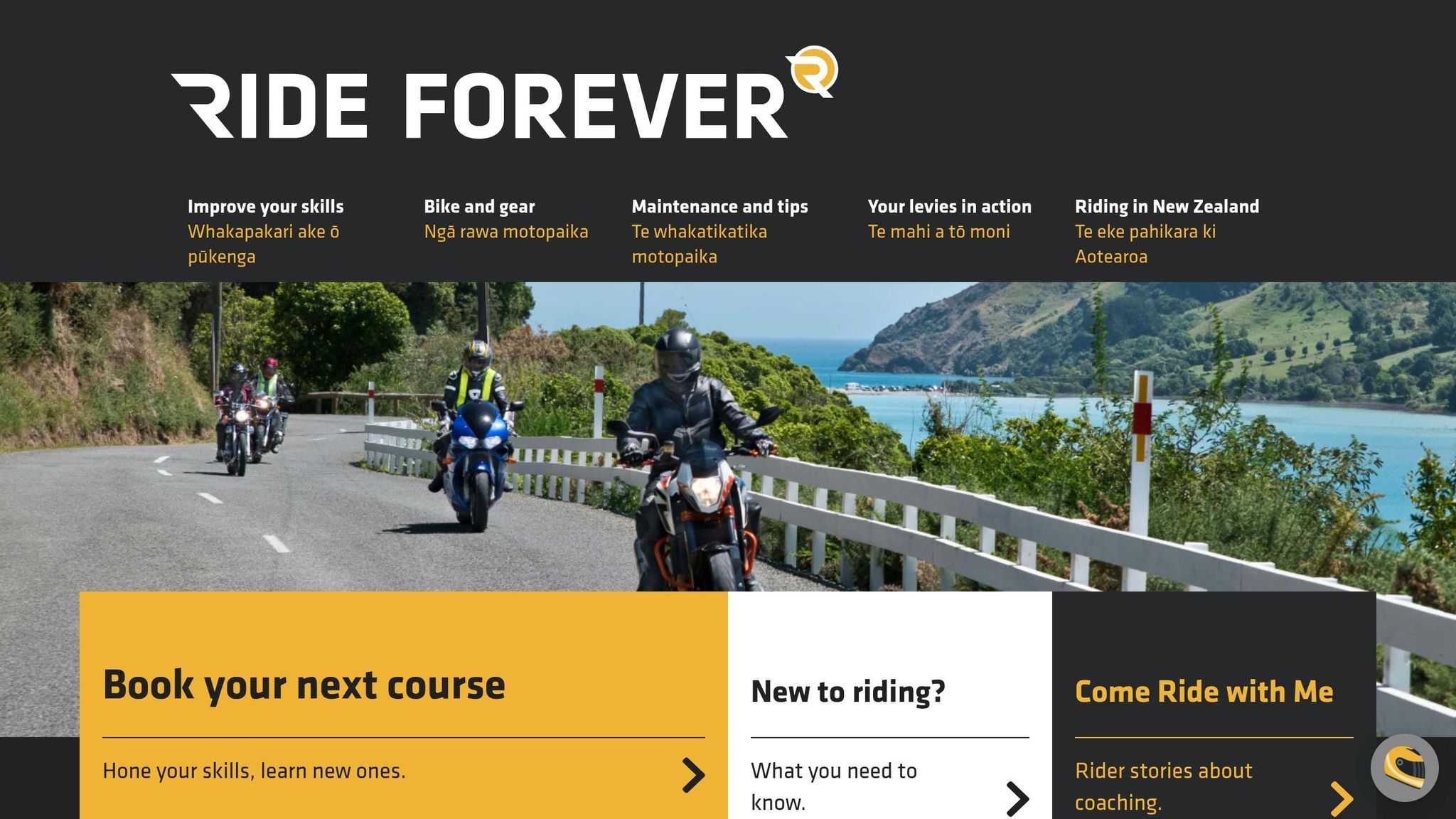
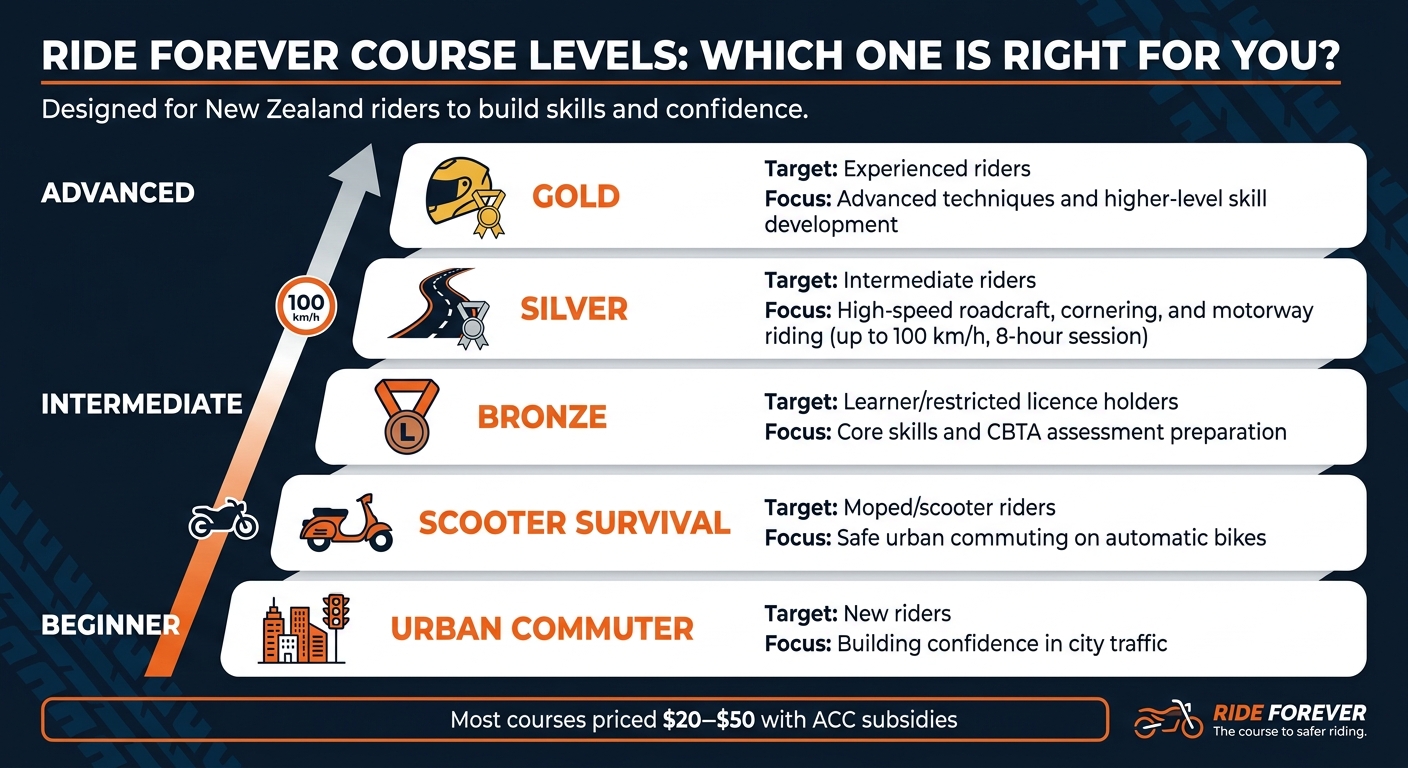
Ride Forever Course Levels: Which One Is Right for You?
Ride Forever courses take the safety conversations sparked by events like Shiny Side Up and turn them into practical skill-building opportunities. Supported by ACC (Accident Compensation Corporation), Ride Forever is New Zealand's national motorcycle coaching programme, tailored to improve rider skills for every level of experience. Thanks to ACC subsidies, most courses are priced between $20 and $50.
While Shiny Side Up focuses on raising awareness about gear and techniques, Ride Forever is all about developing real-world riding skills. The programme works closely with community safety initiatives, especially during September's Motorcycle Awareness Month. During this time, local councils and transport agencies encourage riders to gear up for safe riding as winter ends. Events like Tauranga's "United We Ride" group ride and Porirua's Women Motorcyclist Safety Event featuring Kathleen Perry help bring riders together, promoting both enrolment and hands-on learning opportunities.
"Whether you're a novice or an experienced rider, there's a Ride Forever course for you." - Tauranga City Council
Course Types and Safety Skills
Ride Forever offers a structured approach to motorcycle training, with courses tailored to suit different experience levels:
| Course Level | Target Audience | Key Focus |
|---|---|---|
| Urban Commuter | New riders | Building confidence in city traffic |
| Scooter Survival | Moped/scooter riders | Safe urban commuting on automatic bikes |
| Bronze | Learner/restricted licence holders | Core skills and CBTA assessment preparation |
| Silver | Intermediate riders | High-speed roadcraft, cornering, and motorway riding |
| Gold | Experienced riders | Advanced techniques and higher-level skill development |
Each course is designed to provide targeted, actionable skills. For example, the Silver course is an 8-hour session covering advanced cornering techniques and motorway riding at speeds up to 100 km/h. Riders also learn how to manage slippery roads during wet conditions, with small group sizes ensuring personalised attention.
Gear Requirements for Ride Forever Courses
To participate in a Ride Forever course, riders need to wear appropriate gear. This includes a helmet, gloves, jacket, pants, and boots that cover all skin. Additionally, your motorcycle must meet Warrant of Fitness (WoF) standards, have a full tank of fuel, and properly inflated tyres.
If you're unsure whether your gear meets the standards, Moto 1 offers a range of helmets, gloves, boots, and jackets designed for riders' needs.
The next section will delve deeper into Motorcycle Awareness Month and its initiatives.
Motorcycle Awareness Month and Local Council Campaigns
Motorcycle Awareness Month (MAM) takes place every September throughout New Zealand, aligning with the beginning of the spring riding season. As riders dust off their bikes after winter, local councils use this time to spotlight safety. While initiatives like Shiny Side Up and Ride Forever courses focus on improving rider skills and promoting safety gear, councils amplify these efforts with events tailored to their communities. These campaigns often blend national resources from NZ Transport Agency Waka Kotahi and Ride Forever with local insights to maximise impact.
Typical Community Activities
During MAM, councils organise events that focus on key aspects of motorcycle safety, such as licensing, gear education, and basic bike upkeep. These events give learner riders opportunities to explore LAMS-compliant bikes, chat with Ride Forever trainers, and participate in hands-on sessions about road gear, often emphasising MotoCAP-rated equipment. Workshops on basic motorcycle maintenance are also popular, ensuring bikes are road-ready after winter.
Many of these events are free, and some regions even provide fully funded Ride Forever courses at Bronze, Silver, and Gold levels as part of their road safety initiatives. Beyond these general activities, councils adapt their campaigns to meet the needs of local riders, creating region-specific safety programmes.
Regional Safety Campaign Examples
Local councils across New Zealand take different approaches to MAM, tailoring their campaigns to address the unique challenges and demographics of their regions. Here are some standout examples:
- Christchurch City Council joined forces with Waimakariri District Council, Selwyn District Council, and Waka Kotahi in September 2024 to host the "Kickstart LAMS Bike and Licence Expo" at the Air Force Museum in Wigram. This free event showcased LAMS bike displays, offered licensing advice from Ride Forever experts, and featured MotoCAP gear demonstrations. Attendees could also win motorcycling gear and vouchers.
- Whakatāne District Council, through its Eastern Bay Road Safety Programme, organises an annual MAM event every September at Underwood and Wilkins Motorcycles. Recognising motorcyclists as one of the highest-risk groups in the Eastern Bay of Plenty, the region has increased funding to support unlicensed riders and other high-risk groups. The event includes bike maintenance workshops and promotes funded Ride Forever courses.
- Porirua City Council took a youth-centred approach by hosting a free safety day at Aotea College on 31 March 2026. This event was specifically designed for young riders, focusing on safety education and the importance of proper gear in a relaxed, community-driven environment.
These examples highlight how MAM campaigns are tailored to fit the specific needs of each region. To find out what’s happening in your area, check your local council’s website or Facebook page in August and September.
Club and Charity Rides with a Safety Focus
Motorcycle clubs and charity rides in New Zealand place a strong emphasis on safety, with protocols designed to ensure both group and individual rider security. From structured formations to strict gear requirements, these events promote responsible riding habits that riders can carry into their daily journeys.
Safety Practices in Group Rides
Safety during club rides is maintained through disciplined group organisation. Large groups are broken into smaller units of 4–5 riders to minimise traffic interference and maintain a steady formation. Less experienced riders are placed directly behind the lead rider for closer supervision, ensuring they can follow the pace and guidance easily. On open roads, riders adopt a staggered formation, maintaining a 2-second gap for better visibility and reaction time. When approaching curves, the formation shifts to single file, with the tail-ender controlling the pace to ensure no one is left behind. Charity rides follow similar safety measures, creating a secure environment for all participants.
Charity Rides That Support Safety Awareness
Charity rides across New Zealand also integrate comprehensive safety protocols. For instance, the Te Anau Basin Trail Ride, hosted by the Gore & Districts Motorcycle Club, celebrated its eighth year as an MNZ-permitted event in February 2026. Held at Manapouri Station, the event featured 46 km of tracks divided into Main, Family, Advanced, and Peewee loops. Safety was a top priority, with Hato Hone St John present on-site before any riders began, and restrictions placed on certain vehicles, such as banning Side-by-Sides and limiting ATVs in advanced sections.
"Safety is paramount so any instructions from event organisers to close trails, stop riding, return to Base, etc must be obeyed." - Te Anau Basin Trail Ride Organisers
The MR Motorcycles Charity Trail Ride Series (2025/2026 season), organised with the Naike Community, also upheld strict safety measures. Taking place in locations like Paparimu and Waikaretu, the event required all participants to wear helmets, protective motorcycle boots, and carry fire extinguishers. Pillion passengers were not allowed on the 30–40 km loops.
Warm Kiwi NZ, a women’s motorcycling group, combines charity efforts with rider skill development. Their March 2025 event in Parakai, Auckland, raised $4,165 for Woven Earth, a charity aiding survivors of domestic violence. The event also partnered with professionals like Ride Craft Rider Training to provide hands-on safety training for participants.
"With a highly experienced riding instructor, they provide practical skills and confidence to help riders stay safe on the road." - Ride Craft Rider Training
These examples highlight the community's dedication to fostering safer riding practices on New Zealand roads. Before joining a club or charity ride, ensure the event has MNZ authorisation and check the specific gear requirements, as additional items like protective boots or fire extinguishers may be necessary.
How to Find Rider Safety Events Near You
Knowing where to find rider safety events is an important step in staying connected with the riding community and prioritising safety. These events not only enhance skills but also foster a sense of camaraderie among riders.
Reliable Sources for Event Information
The Ride Forever website is a great starting point for nationwide safety initiatives supported by ACC. For those into off-road and enduro riding, Silver-Bullet (silverbullet.nz) offers New Zealand's most comprehensive motorcycle event calendar. Additionally, Motorcycling New Zealand (MNZ) provides a mobile app where you can search for events by region, manage licences, and get news updates directly on your device.
Local councils are another excellent resource. Many have dedicated road safety pages and host free workshops or safety evenings. For instance, the Christchurch City Council's "Let's Talk" platform allows riders to sign up for email updates on local safety projects.
"Sign up today to find out about projects that matter to you and your whānau." - Christchurch City Council
Social media is also helpful. Follow your local council on Facebook for timely updates about Ride Forever courses, community workshops, and other road safety events in your area.
| Resource | Best For |
|---|---|
| Ride Forever | On-road safety courses, commuters, new riders |
| Silver-Bullet | Trail, enduro, and adventure events |
| MNZ App/Website | Club events and regional competitions |
| Local Council Websites | Free community workshops, safety evenings |
With these resources, you have a range of options to find events that align with your interests and needs.
Choosing Events Based on Your Riding Style
Once you've identified potential events, focus on those that fit your riding style. If you’re a commuter or returning rider, Ride Forever courses are a practical choice. These courses, available at Bronze, Silver, and Gold levels, are often free thanks to regional funding, such as the Eastern Bay Road Safety Programme.
Tourers and road riders will benefit from events during Motorcycle Awareness Month in September. This period is packed with safety events, coinciding with the time when over half of New Zealand riders return to the roads after winter.
For adventure and off-road riders, Silver-Bullet’s event calendar is ideal. It allows you to filter events by trail, enduro, and motocross categories. Subsidised training days are another option to consider, often funded by council partnerships. For example, in September 2025, Waikato, Hamilton, and Waipa councils sponsored a training day at the Kartsport Club in Hamilton for experienced and returning riders.
These tailored opportunities ensure there’s something valuable for every type of rider.
Conclusion: Getting Involved and Riding Safer
Across New Zealand, there are plenty of community events aimed at helping riders sharpen their skills and improve their approach to safety gear. These events are part of a broader effort to keep riders safer on the road. Whether you're just starting out with your licence or you're a seasoned rider shaking off the winter cobwebs, there's something for everyone - and many of these events are completely free.
These local gatherings offer practical safety education, giving riders direct access to Ride Forever experts, insights on MotoCAP gear, and the chance to see LAMS-approved bikes up close. It's an opportunity to gain hands-on experience and build confidence - something you simply can't get from reading a manual. Events like these turn expert advice into practical knowledge you can use every day on New Zealand's roads.
Another key focus of these events is gear. They remind riders that what you wear is just as crucial as how you ride. If you've been holding off on upgrading your helmet, jacket, or gloves, these gatherings are a great chance to get the ball rolling.
For riders looking to invest in high-quality safety gear, Moto 1 is a trusted source. They stock a wide range of protective equipment, from helmets and jackets to gloves and boots, catering to road, adventure, and motocross riders. Having the right gear means you can make the most of every training session and group ride.
If you're wondering where to start, the easiest step is to choose one event this season and go. Check your local council's event calendar, stay updated with the Ride Forever programme, and keep an eye out for activities during Motorcycle Awareness Month in September. With better skills, stronger connections, and the right equipment, every ride becomes a safer one.
FAQs
Which rider safety event should I go to first?
Mark your calendars! On 31 March 2026, Aotea College will host a free safety day tailored specifically for young motorcyclists. The event, titled "Gear up & chill out", aims to equip young riders with the knowledge and skills needed to stay safe on the road.
This initiative focuses on essential safety practices, making it a must-attend for anyone keen to enhance their riding habits and confidence. Whether you're new to motorcycling or looking to brush up on your safety skills, this event promises to be both educational and engaging.
Do I need full gear and a WoF to attend a Ride Forever course?
You don’t need full riding gear or a current WoF to join a Ride Forever course. However, you will need a valid motorcycle licence and your own bike to take part.
How can I find Motorcycle Awareness Month events near me?
You can discover Motorcycle Awareness Month events in your area by visiting local council websites or checking community boards for updates. For instance, Christchurch will host the Kickstart LAMS Bike and Licence Expo on 22 September 2024, while Porirua is organising a free safety day for young riders on 31 March 2026. You can also explore online platforms that list motorcycle events or reach out to local motorcycle clubs for additional details.