

Heavier bike gear is not always safer. If I want gear that gives me the best shot in a crash, I need to check independent safety ratings, proper fit, and whether I’ll wear it every ride.
Here’s the short version:
- Helmet first: Riding without one sharply lifts the risk of head injury or death.
- Weight alone means little: A heavier helmet, jacket, or pair of pants is not automatically safer.
- Standards matter more: For helmets, look for ECE 22.06. For clothing, check EN 17092 and CE armour levels.
- Fit matters: Armour has to stay in place. A loose armour motorcycle jacket or pants can fail where it counts.
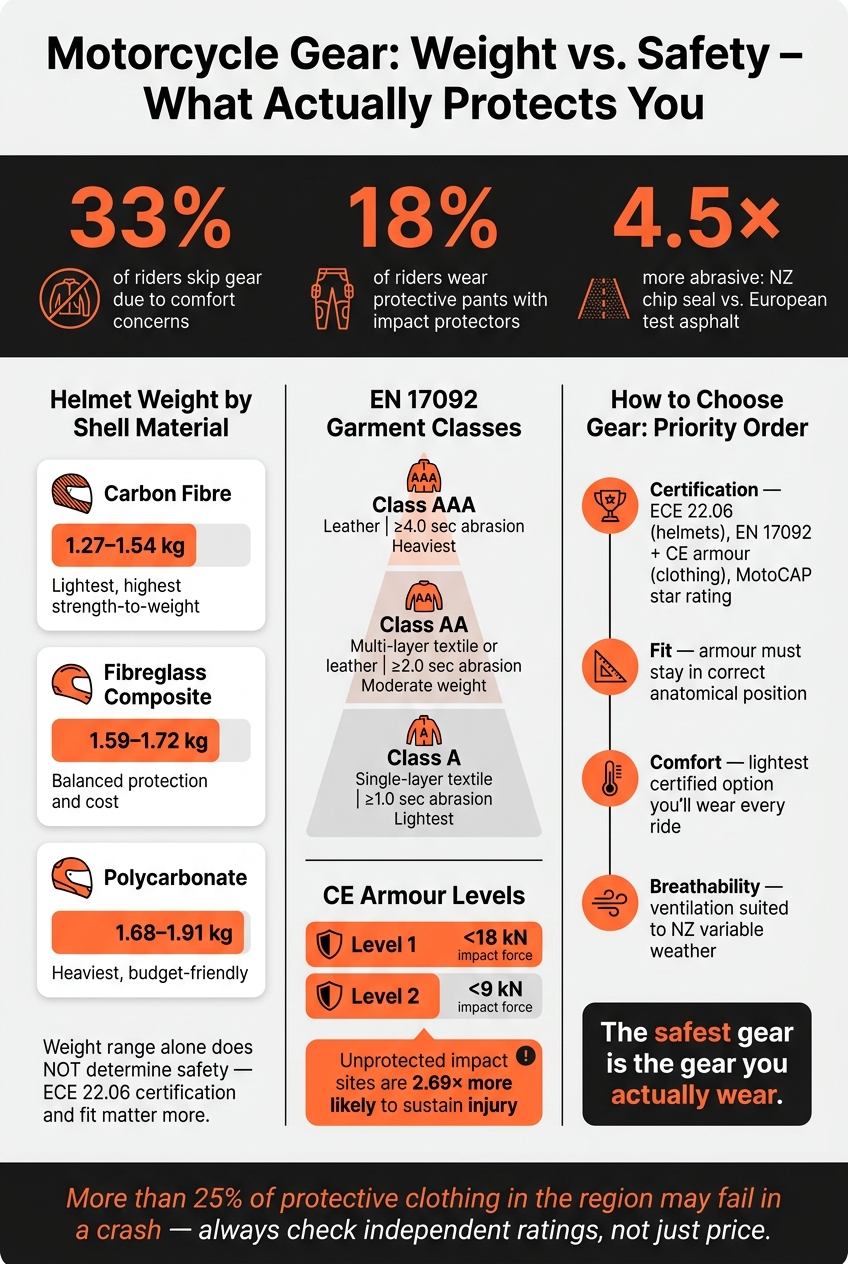
- Comfort affects use: If gear feels too hot, heavy, or awkward, many riders stop wearing it. Research in the article notes 33% skip or avoid gear due to comfort, and only 18% wear protective pants with impact protectors.
- NZ roads are harder on gear: MotoCAP says New Zealand chip seal is 4.5 times more abrasive than the test asphalt used in Europe.
- Best buying rule: I’d buy to standard first, fit second, then choose the lightest option I’m happy to wear often.
If I were comparing gear fast, I’d judge it on four things: certification, fit, comfort, and breathability. That gives a better answer than just picking the heaviest item on the rack.
Motorcycle Gear Safety: Weight vs. Protection – Key Stats & Standards
How Safe Is Your Motorcycle Gear? CE Abrasion Ratings Explained
sbb-itb-bfda696
Quick comparison
| Gear area | What to check first | What weight tells me | Main trade-off |
|---|---|---|---|
| Helmet | ECE 22.06, fit, retention | Very little on its own | Lighter helmets can cut neck fatigue, but fit and test standard matter more |
| Jacket | EN 17092 class, armour level, MotoCAP | Some clue about materials, not crash outcome by itself | More protection often means more heat and bulk |
| Pants | EN 17092 class, armour position, comfort | Some clue about coverage, not enough to judge safety | Heavier pants may protect more, but riders often skip them |
| Gloves | Protection, fit, feel at controls, breathability | Little on its own | More padding can reduce feel and add heat |
That’s the core point of the article: the safest gear is certified, fits well, and gets worn.
Helmet weight versus head protection
A helmet's weight doesn't tell you much about how well it'll protect you. The big things are fit, certification, and whether the helmet stays put. Even when a helmet is fastened the right way, it can still roll off or get thrown clear in a crash if the retention system isn't up to scratch.
Crash data shows full-face helmets record fewer head injuries than half-face or open-face designs. That points to a simple truth: coverage and fit matter far more than the number on the scales.
How helmet safety standards work
For New Zealand road riders, ECE 22.06 is the latest European standard and a strong yardstick for modern impact testing. It covers both high- and low-speed impacts, along with rotational resistance. You'll also see DOT (FMVSS 218), which is a US standard, on some helmets, while Snell 2020 is a voluntary certification.
Retention tests check if the helmet stays secure under crash loads. So helmet safety comes from the whole setup: shell, liner, fit, and retention. Not just the material.
Shell materials, typical weights and trade-offs
Material affects weight, but it doesn't replace fit or certification.
This is where weight gaps show up most clearly. Carbon fibre has the highest strength-to-weight ratio and can cut helmet weight by 15–25% compared with fibreglass, which can ease neck fatigue on longer rides. Fibreglass composite sits in the middle. Polycarbonate is usually the heaviest option because it needs more material to meet safety standards.
A low-profile shell can feel more settled at speed and quieter in the wind. Carbon fibre shells are often thinner than polycarbonate shells while still maintaining high impact resistance.
Approximate weight ranges vary by model.
| Shell Material | Typical Weight Range | Strengths | Drawbacks |
|---|---|---|---|
| Carbon Fibre | 1.27–1.54 kg | Lightest option; reduces neck fatigue; high strength-to-weight ratio | Most expensive; can be noisier |
| Fibreglass Composite | 1.59–1.72 kg | Good balance of protection and cost; often quieter | Heavier than carbon |
| Polycarbonate | 1.68–1.91 kg | Budget-friendly; durable for daily use | Heaviest option; bulkier profile |
It's also worth checking for multi-density EPS liners, which manage both high- and low-speed impacts better than single-density foam. Systems like MIPS (Multi-directional Impact Protection System) add a layer that can move on its own inside the helmet, which helps cut rotational forces in angled impacts. These features add very little weight, but they can matter a lot in a crash.
The same weight-versus-protection trade-off becomes even clearer in jackets, pants, and armour.
Jackets, pants and armour: weight versus injury reduction
Extra layers and tougher materials do add weight to a jacket or pair of pants. But that weight isn’t just there for show. It helps the gear handle abrasion and impact better, as long as the garment and armour meet recognised safety standards. So the main trade-off isn’t just weight by itself. It’s how much protection you get for the bulk you’re carrying.
What research shows about abrasion and impact protection
The main standard for motorcycle garments is EN 17092. It replaced the older EN 13595 standard. EN 13595 was aimed at professional riders, such as couriers, while EN 17092 was built for leisure and road use, which makes it more relevant to everyday riders.
EN 17092 rates garments by abrasion resistance using three classes: A, AA, and AAA. Garments must also meet seam-strength rules and hole-size limits. That seam-strength part matters more than many riders think. If a seam splits open in a crash, skin can be exposed just as badly as if the fabric itself had worn through.
Armour is tested under EN 1621. CE Level 1 armour reduces impact force to under 18 kN on average, while CE Level 2 reduces it to under 9 kN. But armour only works when it stays where it’s meant to be. That means the garment needs to fit snugly enough to keep the protectors in the right anatomical position during a slide.
Lightweight textile, armoured textile and leather compared
Class AAA gear gives the highest abrasion protection, but there’s no free lunch. The extra weight, heat, and bulk can make it less practical for everyday use.
| Garment Type | Weight/Bulk | EN 17092 Class | Abrasion Resistance | Comfort Notes for NZ Conditions |
|---|---|---|---|---|
| Single-layer Textile | Lightest | Class A | ≥ 1.0 sec | Best for urban riding and hot weather; low bulk and high breathability. |
| Multi-layer Textile with Armour | Moderate to heavy | Class AA | ≥ 2.0 sec | Balanced for touring and commuting; often offers weather protection and good versatility. |
| Leather | Heaviest | Class AA–AAA | ≥ 2.0–4.0 sec | Highest abrasion resistance; can be hot, less breathable, and more restrictive. |
There’s another practical detail that’s easy to miss: garments must not shrink by more than 5% after five standardised washes. That helps keep the armour sitting where it should, so it can still do its job.
For New Zealand’s mixed riding conditions, Class AA gear with CE Level 2 armour is often the most sensible middle ground. It gives strong protection without the extra heat and bulk that can come with full AAA gear.
That matters most in day-to-day riding, because bulky gear only helps if people keep wearing it.
Mobility, fatigue and wearing gear on every ride
Gear only helps if you wear it every ride. That sounds simple, but the habit breaks down fast when gear feels awkward, hot, or heavy. In fact, 33% of riders globally cite comfort concerns as a reason for not wearing or consistently adopting protective gear. That matters even more on short trips, where small hassles are often enough to leave gear hanging at home.
How weight and bulk affect rider performance
Weight and bulk limit movement and add fatigue. Multi-layer protective materials can reduce rider flexibility by up to 15%, which can make simple actions feel less natural, like turning your head for shoulder checks or settling into a relaxed riding position. Adding CE-rated armour typically lifts total gear weight by nearly 20%, and that extra weight can wear on you over a longer ride.
Gloves are a good example of the trade-off. They need to protect your hands without dulling your feel for the throttle, brakes, and switches. Thick or badly fitted gloves can cut the dexterity needed for fine control. Then there’s heat. Roughly 32% of riders in warmer climates avoid heavy protective gear because of heat build-up. In New Zealand, where a ride can start in a cool morning and end in a warm afternoon, gear that holds too much heat can become a pain to keep on.
Balancing protection and comfort for daily riding
Research from the Novice Rider Study found that wearability is just as influential as social factors when it comes to whether riders use protective equipment all the time. Lead researcher Rebecca Ivers noted:
"Practical wearability issues and social influences also play critical roles in determining actual usage."
That helps explain why only 18% of all riders wear protective pants with impact protectors. Pants often feel bulkier than jackets, and riders tend to notice movement limits more in the hips and knees. For daily riding, the big question isn’t just how protective the gear is on paper. It’s whether it still feels normal after an hour on the bike.
The table below shows where those trade-offs tend to land.
| Setup Type | Total Weight Impact | Wearing Consistency |
|---|---|---|
| High-Mass (Max Protection) | High - heavy leather, Level 2 armour | Lower - often skipped in heat or for short commutes |
| Moderate-Mass (High Comfort) | Moderate - armoured textile, Level 1 armour | Higher - comfortable enough for daily use in all weather |
Research from Neuroscience Research Australia backs this up: unprotected impact sites are 2.69 times more likely to sustain injury than protected ones. So the smartest setup is usually the one that you’ll put on without thinking twice. That puts fit, weight, and certification right at the top of the buying checklist.
Next, check the labels that separate light gear from genuinely protective gear.
What New Zealand riders should look for when buying gear
For New Zealand riders, the best order is simple: buy to standard first, fit second, then pick the lightest gear that still feels comfortable on the bike. That matters even more on New Zealand roads, where rough surfaces and fast-changing weather can make a “light” option less appealing once you’re out riding.
MotoCAP notes that New Zealand chip seal is 4.5 times more abrasive than standard European test asphalt. So if a piece of gear only just meets the minimum under EN 17092, that may not show the full picture for local riding. Checking MotoCAP star ratings alongside CE certification gives a clearer view of how gear may perform on the road.
Price also doesn’t tell you much on its own. MotoCAP reports that more than 25% of protective clothing worn by riders in the region is poor quality and may fail during a crash. In plain terms, a higher price tag is not a safe shortcut. Independent ratings are the better check.
How to check gear specifications on Moto 1
Once you know which standard you need, the next step is the product page. That’s where you can check the details that shape fit and day-to-day comfort.
On Moto 1, look at each product page for certification, armour coverage, materials, and ventilation, with prices shown in NZ$.
New Zealand weather can swing from cool and wet to warm and windy in a single ride. Because of that, it helps to compare MotoCAP ventilation ratings with the product-page details, so you can judge how well each item may handle heat on the bike.
Conclusion: certified, well-fitted gear that gets worn
The clearest takeaway from the study is this: gear only helps if riders will actually wear it. Use this checklist to compare options in a quick, consistent way:
- Certification: ECE for helmets, CE for armour, MotoCAP star ratings for real-world performance
- Fit: armour stays in the correct anatomical position throughout the ride
- Comfort: the lightest certified option that remains wearable on every ride
- Weather: ventilation rating suited to New Zealand's variable conditions
FAQs
Is lighter gear safer?
Yes, lighter gear can be safer if it uses advanced materials and still keeps protection intact.
Modern impact protectors can be lightweight, thin, and flexible. That can help cut heat stress and improve comfort, which may also support safer riding.
What safety labels should I check first?
Check that your helmet meets DOT FMVSS 218 and has the DOT symbol on it.
It’s also worth looking inside the helmet for Snell or ANSI labels. Those labels show the helmet meets recognised safety standards.
How do I know if my gear fits properly?
Your motorcycle gear should cover the key parts of your body and fit snugly without being too tight or too loose. The goal is simple: it needs to stay in place in a crash, while still letting you move with ease.
A helmet should sit firmly on your head without too much movement. Gloves, jackets, pants, and boots should all fit securely, but they shouldn’t cut off circulation or make it hard to grip, bend, or move.
If you can, try your gear on before you ride. Check how it feels, how well it covers you, and whether it stays in place when you move around.