

When choosing a motorcycle jacket in New Zealand, the unpredictable weather plays a big role. Windproof jackets block cold air and are great for colder, wetter conditions, while regular jackets focus on ventilation, making them ideal for summer rides. Both have pros and cons depending on your riding needs and regional climate.
Key Differences:
- Windproof Jackets: Use materials like GORE-TEX to block wind and rain. Ideal for touring and cold climates. Often include thermal liners and adjustable vents.
- Regular Jackets: Prioritise airflow with mesh panels for hot weather. Some come with removable wind liners for cooler days.
Considerations for NZ Riders:
- Wind Protection: Windproof jackets excel at blocking windchill, essential for highway speeds.
- Weather Range: Laminated windproof jackets handle changing conditions better than regular jackets.
- Safety: Both types offer CE armour, but higher-end options may include stronger materials and better impact protection.
- Cost: Prices range from $299 for basic options to over $1,500 for premium, all-weather jackets.
Quick Comparison:
| Feature | Windproof Jackets | Regular Jackets |
|---|---|---|
| Best Use | Cold, wet, long-distance rides | Summer, urban commuting |
| Materials | Laminated GORE-TEX, MaxTex | Mesh panels, breathable fabrics |
| Wind Protection | Excellent | Moderate (with optional liners) |
| Breathability | Adjustable vents | High (constant airflow) |
| Price Range (NZD) | $299–$1,500+ | $299–$850 |
For New Zealand's varied climate, a modular jacket with removable liners offers flexibility for all seasons, but your choice should match your riding style and typical conditions.
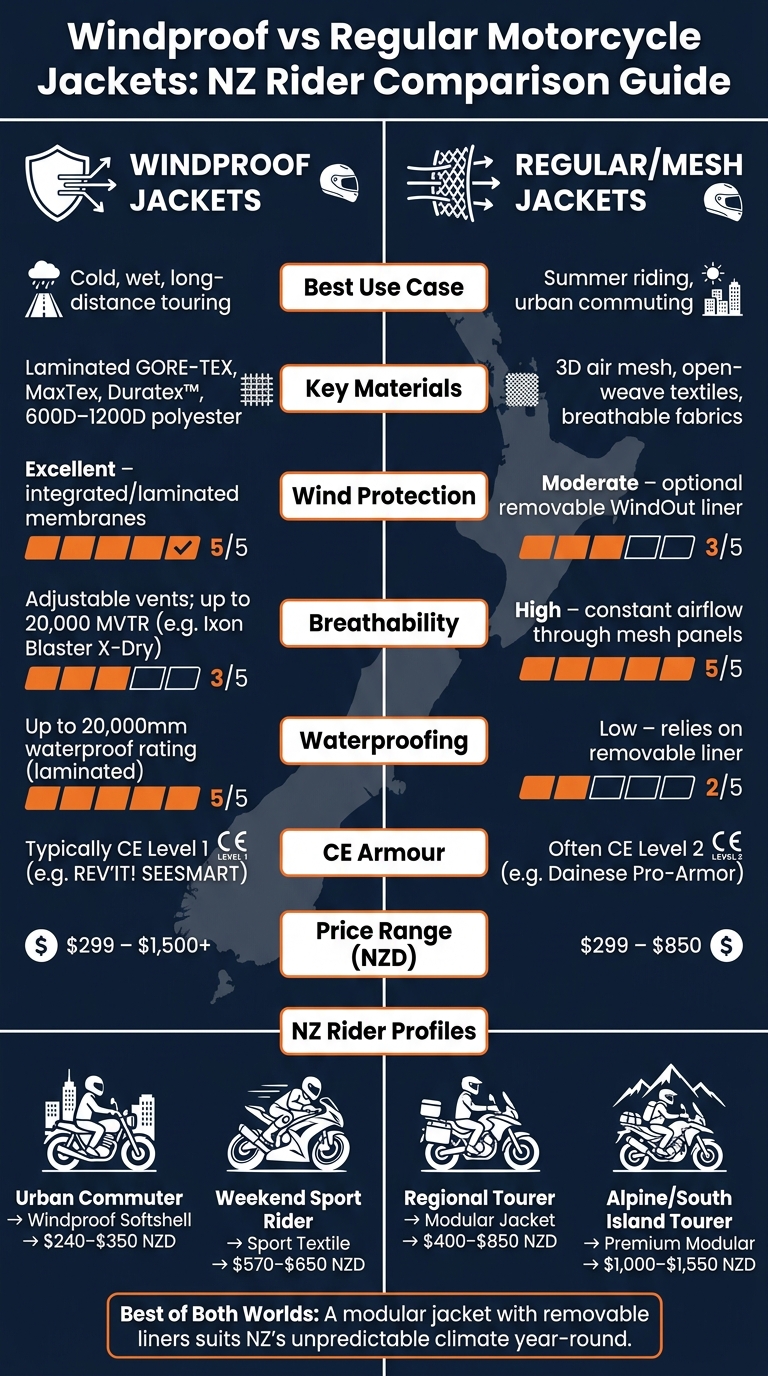
Windproof vs Regular Motorcycle Jackets: NZ Rider Comparison Guide
Windproof and casual motorcycle jackets from RIDEIRON - honest review.

sbb-itb-bfda696
How Windproof Motorcycle Jackets Work
The main distinction between windproof and regular jackets lies in how they manage airflow. Windproof jackets are designed to block air from penetrating, while regular jackets allow air to circulate freely. This difference is particularly important in New Zealand, where the weather can change quickly. Understanding these features helps riders choose the right jacket for their needs, balancing performance, protection, and comfort.
Windproof Jacket Features
Windproof jackets are built with tightly woven outer fabrics such as 600D or 1200D polyester, MaxTex, or Duratex™. These are often paired with laminated membranes like GORE-TEX or X-Dry. For example, the X-Dry membrane offers 14,000 Schmerber water resistance and 20,000 MVTR breathability, ensuring wind and rain are kept out while allowing moisture from your body to escape.
Additional protective features include bonded membranes and sealed openings. Adjustable collars with shock cords, hook-and-loop cuff flaps, and 360-degree connection zippers (to attach the jacket to riding pants) further enhance wind-blocking capabilities.
"The jacket's slim and comfortable, ergonomic collar with direct closure and shock cord adjustment effectively seals the neck area and keeps out the rain, wind and colder weather." - Alpinestars
Regular Jacket Features
Regular jackets are all about airflow. They use materials like 3D air mesh and open-weave textiles to maximise ventilation. This makes them ideal for summer rides, but it also means cold air can pass through easily, which can be uncomfortable at higher speeds.
Some regular jackets come with removable "WindOut" liners for added versatility. These liners act as a barrier against wind on cooler days but are not integrated into the jacket itself.
"The WindOut membrane improves thermal protection in case of lower temperatures." - SPIDI
These design differences significantly affect how each jacket handles windchill, especially when riding at highway speeds.
The Effect of Windchill
Windchill becomes a major factor at higher speeds, as the continuous airflow can rapidly lower your body temperature. Windproof jackets combat this with built-in wind-blocking layers and, in many cases, removable thermal liners. These liners, usually ranging from 80g to 130g of insulation, provide warmth without adding unnecessary bulk, making them adaptable to changing weather conditions. This ability to regulate body temperature is crucial for maintaining focus and reaction time while riding.
| Feature | Windproof Jackets | Regular/Mesh Jackets |
|---|---|---|
| Primary Material | Laminated GORE-TEX, MaxTex, or Duratex | 3D air mesh and heavy mesh panels |
| Wind Protection | Integrated or laminated membranes | Optional removable "WindOut" liner |
| Airflow Strategy | Closable ventilation ports | Permanent mesh for constant airflow |
| Best Use Case | Touring, wet weather, and cold climates | Summer riding and urban commuting |
Performance Comparison
Wind Protection and Warmth
Windproof jackets are designed to keep cold air out, thanks to features like laminated membranes and detachable thermal liners. In contrast, regular jackets made with heavy-duty polyester might let cold air seep through seams and zippers, especially at highway speeds. To prevent overheating in warmer weather, windproof jackets often include adjustable vents, such as those on the chest and back. This adaptability makes them stand out when it comes to handling different weather conditions.
Weather Range
Laminated windproof jackets shine across various weather conditions. Take the Alpinestars ST-7 Prime GORE-TEX, for example. Its 2-layer laminated shell combined with a removable thermal liner ensures reliable performance throughout the year.
"The ST-7 PRIME GORE-TEX Jacket is a perfect choice for touring riders and urban commuters looking for a refined protective motorcycling jacket that offers year-round, comfort, breathability, and optimal wet weather performance." - Alpinestars
On the other hand, regular jackets might need extra layers to provide sufficient protection against the elements. While layering can help, it often adds bulk and may not match the seamless performance required for New Zealand's unpredictable weather.
Breathability and Seasonal Use
Breathability is another critical factor for comfort, especially when riding through seasonal changes. Regular jackets with large mesh panels perform well in summer, but premium windproof models now rival this with advanced membranes offering high breathability ratings. For instance, the Ixon Blaster's X-Dry membrane achieves an impressive 20,000 MVTR rating, while the Leatt 8.5 ADV MultiTour offers 15,000g/m². Designed in Aotearoa, the Ground Effect Flash Gordon boasts an 18,000 gm/m²/24hr breathability rating alongside a 20,000mm waterproof rating.
For riders in New Zealand, where conditions can swing from cold southerlies in Otago to warm summer days in Northland, a modular windproof jacket with a removable liner and adjustable ventilation is a versatile choice. It eliminates the need for multiple jackets, making it a practical solution for the country's diverse climate.
| Jacket | Windproof/Waterproof Type | Breathability Rating |
|---|---|---|
| Ixon Blaster | Fixed X-Dry Membrane | 20,000 MVTR |
| Leatt 8.5 ADV MultiTour | Removable HydraDri® Shell | 15,000g/m² |
| Ground Effect Flash Gordon | 3-layer laminated (silicone-treated) | 18,000 gm/m²/24hr |
| Dririder Vortex Adventure 2 | Removable Liner | 7,000mm (waterproof rating) |
Protection and Safety Features
Impact Protection
Windproof jackets often incorporate CE Level 1 protectors, such as REV'IT! SEESMART pads, designed to keep the jacket lightweight and flexible while maintaining a Class AA safety rating. In contrast, regular and touring jackets tend to come equipped with CE Level 2 armour, like Dainese's Pro-Armor, which provides a higher level of impact absorption. Deciding between CE Level 1 and Level 2 armour largely depends on your riding conditions and the specific performance needs discussed earlier.
Back protection is another critical factor. Most jackets in both categories include a pocket for a back protector, but the actual protector is usually sold separately. Riders often need to purchase a CE Level 2 back insert to complete their setup. For those frequently navigating New Zealand's open highways or gravel roads, upgrading to a Level 2 back protector is a simple yet effective way to boost safety without replacing the entire jacket. This impact protection pairs with the durability of the jacket’s materials to offer comprehensive safety.
Material Durability
The outer shell material is where windproof and regular jackets diverge significantly. Regular jackets typically feature high-denier fabrics, such as 600D polyester as a base, reinforced with 1,200D or Ballistic textiles at key areas like the shoulders and elbows. Premium models, such as the REV'IT! Dominator 3 GTX, take it a step further by combining 3-layer GORE-TEX Pro with Armacor fabric, offering exceptional abrasion resistance.
Windproof jackets, on the other hand, utilise softshell or WindBarrier® fabrics. These materials consist of a laminated membrane layered between a stretchable outer surface and a fleece inner lining. While this construction is lighter and more flexible, it doesn’t match the abrasion resistance of the heavy-duty textiles found in regular jackets. As REV'IT! explains:
"More than just a fashionable statement, it offers lightweight comfort along with CE-level 1 SEESMART armor at the shoulders and elbows and an AA safety rating - making it truly ride-ready." - REV'IT!
Both types of jackets can achieve a Class AA safety rating, but riders tackling long distances or rough terrain often benefit from the enhanced durability of regular jackets. A secure fit is also crucial to ensure the protective features perform as intended, especially in challenging conditions.
Fit and Closure Systems
The fit of a jacket plays a huge role in how well its armour performs during an accident. Misaligned shoulder or elbow pads can compromise protection, so ensuring a proper fit is key. High-quality jackets often include features like waist adjusters, cuff straps, and connecting zippers to riding pants. These elements help stabilise the jacket during a slide, keeping the torso covered and the armour in place.
Windproof jackets also incorporate wind catchers behind the main zipper and snap-down hoods to prevent air from inflating the jacket while riding at speed. Regular sport-cut jackets, like the Ixon Blaster, use a snug roadster cut to minimise drag without the need for additional closures. Both approaches are effective, as long as the jacket fits securely enough to prevent shifting while riding.
Value and Use Cases for New Zealand Riders
Cost Considerations
In New Zealand, jacket prices span a wide range, and understanding the options can help you make an informed decision. For those on a budget, entry-level textile jackets like the Oxford Metro 2.0 ($299.90 NZD) and the RST S-1 ($299.00 NZD) provide basic features such as fixed waterproof membranes and simple thermal inserts. These are great for urban commuters who need reliable gear without breaking the bank.
For riders seeking more versatility, mid-range modular jackets like the REV'IT! Outback 4 H2O ($699.00 NZD) include detachable thermal and waterproof liners, making them suitable for changing weather conditions. At the premium end, options like the Leatt 8.5 ADV MultiTour ($1,549.99 NZD) offer a 5-way configuration, allowing it to function as a mesh summer jacket, a windproof mid-layer, or a fully waterproof touring jacket. This level of flexibility is ideal for those travelling long distances across varied terrain, where stopping to adjust gear isn't always convenient.
Ownership Approaches
Your approach to owning riding gear can also influence your jacket choice. Some riders prefer investing in a modular jacket that adapts to different conditions, while others opt for multiple jackets tailored to specific seasons or activities. For example, a summer mesh jacket (around $300 NZD) paired with a winter touring jacket (around $600 NZD) delivers excellent seasonal performance but requires extra storage and effort to switch between them.
On the other hand, a high-quality modular jacket, though more expensive upfront, eliminates the need for multiple jackets and can handle a variety of conditions seamlessly. However, modular jackets do require additional care - removable liners often need to be washed and stored separately. Laminated jackets, where the waterproof layer is bonded to the outer shell, offer easier maintenance and faster drying times, which is particularly useful for riders in consistently wet regions like Auckland or the West Coast.
Riding Style and Terrain
The type of riding you do and the terrain you cover are just as important as cost and ownership considerations. New Zealand’s diverse landscapes mean that the right jacket can vary depending on your location and riding habits. For instance, Wellington commuters tackling windy short trips might prefer a windproof softshell priced between $240 and $350 NZD.
If you’re a weekend rider exploring scenic routes like the Coromandel or the Thermal Explorer Highway, a sport textile jacket with a fixed waterproof membrane, such as the Ixon Blaster ($579.00 NZD), offers weather protection without unnecessary bulk.
Touring enthusiasts venturing into the Southern Alps or Otago, where temperatures can fluctuate dramatically, should consider a modular adventure jacket with a removable windproof liner. Many of these jackets also include hydration bladder pockets, a feature that’s particularly handy on remote South Island roads with limited stops.
For those ready to explore their options, Moto 1 provides a wide selection of jackets at various price points and offers free shipping on qualifying orders.
| Rider Type | Recommended Jacket Style | Typical NZD Price Range |
|---|---|---|
| Urban Commuter | Windproof softshell or entry textile | $240 – $350 |
| Weekend Sport Rider | Sport textile with fixed membrane | $570 – $650 |
| Regional Tourer | Mid-range modular with removable liners | $400 – $850 |
| South Island / Alpine Tourer | Premium modular, 5-way function | $1,000 – $1,550 |
How to Choose Between Windproof and Regular Jackets
Decision Framework
Picking the right jacket depends on where and when you ride. For instance, if you’re commuting daily in cities like Wellington or Auckland, where trips are short, traffic is stop-and-go, and wind can be unpredictable, a windproof softshell with a fixed membrane is a smart choice. It keeps you comfortable without adding unnecessary bulk or expense. On the other hand, if you’re tackling longer rides across varied terrain, you’ll need something more suited to changing conditions.
At motorway speeds, wind pressure can push water through materials that might work fine at lower speeds. For extended touring - especially on exposed roads or in the South Island - you’ll need a jacket with a waterproof rating of at least 15,000mm. A laminated construction, where the waterproof membrane bonds directly to the outer shell, is ideal for frequent heavy rain. This design prevents the outer fabric from soaking up water, keeping you warmer and drier.
Safety is another key factor. For urban riding, CE Level 1 armour is sufficient. But if you’re travelling longer distances at higher speeds, CE Level 2 protectors at the shoulders and elbows provide better impact protection. Look for jackets with adjustable features like waist, wrist, and arm straps, as these help reduce flapping on New Zealand’s open roads, which can lead to fatigue and compromise safety.
If you’re considering an airbag system, check the jacket’s compatibility. Some jackets include stretch panels to accommodate airbags, while others may require you to size up.
Use the table below as a quick reference to compare features based on your riding style.
Feature Checklist Table
| Feature | Windproof Softshell | Adventure | Premium Laminated |
|---|---|---|---|
| Example | Oxford Faringdon | Dririder Vortex Adventure 2 | Alpinestars ST-7 |
| Price Range (NZD) | $240 – $300 | $454 – $649 | $1,000+ |
| Wind Protection | High (integrated softshell) | Moderate–High (via liners/heavy shell) | Excellent (bonded membrane) |
| Waterproofing | Fixed membrane (water-resistant) | Removable liner (15,000mm) | Laminated Gore-Tex (fully waterproof) |
| Ventilation | Minimal | Extensive (chest, arm, back vents) | High (hyperflow venting systems) |
| CE Armour Level | Level 1 | Level 1 + foam back pad | Level 2 |
| Best For | Urban commuting, short trips | All-season touring, adventure | Long-distance touring, heavy rain |
Conclusion
The right jacket for your ride depends heavily on your conditions. Windproof softshells are perfect for cold, high-speed rides where windchill is the main issue. On the other hand, regular textile jackets handle a broader range of temperatures - whether you're braving a brisk Wellington morning or enjoying a sunny Northland afternoon. For those wanting versatility, a modular system like the Knox Dual Pro 3-in-1 (NZ$599.00) offers a smart solution. It combines a 10,000mm laminated windproof shell with a removable thermal quilt, making it ideal for New Zealand's famously unpredictable weather. This approach blends the key advantages of both jacket types.
FAQs
Do I need a laminated waterproof jacket for NZ rain?
When deciding if you need a laminated jacket, it all comes down to your riding needs. Laminated jackets, where the waterproof membrane is bonded directly to the outer shell, are perfect for handling New Zealand’s rain. They don’t soak up water and dry much faster. On the other hand, jackets with fixed or drop-liner membranes are dependable for wet commutes or adventurous rides. At Moto 1, there’s a variety of options tailored to different riding styles.
What armour level should my jacket have for highway riding?
When gearing up for highway rides, opt for a jacket equipped with CE-approved armour for critical areas like elbows, shoulders, and spine. For added safety at higher speeds, Level 2 armour is a better choice as it offers superior impact protection. A snug fit is crucial to ensure the armour stays securely in place during a ride. Look for jackets that meet EN1621 standards, but keep in mind that back protectors are often sold separately and need to be inserted into the jacket's designated pocket.
Is one modular jacket better than owning two seasonal jackets?
Yes, modular jackets can be a fantastic option for year-round use. Thanks to their removable thermal linings and waterproof layers, they can handle shifting weather conditions with ease - no need to buy separate jackets for each season. Features like built-in storage for liners and adjustable vents make them practical whether you're riding in chilly rain or under the blazing sun. Opting for a well-made modular jacket from Moto 1 not only streamlines your gear but also ensures reliable CE-approved protection and weatherproofing.