

Adventure helmets are designed for riders tackling both highways and rugged trails, making them ideal for New Zealand's mixed terrain. These helmets combine road and off-road features like sun-shielding peaks, wide eyeports, and impact-protective chin bars. Prices range from $149 for basic models to $1,700 for premium carbon fibre options.
Key Points:
- Safety Standards: Helmets in NZ must meet ECE 22.05/22.06, DOT FMVSS 218, or AS/NZS 1698.
- Construction: Shells made from polycarbonate (affordable), fibreglass (mid-range), or carbon fibre (lightweight, high-end).
- Features: Peaks for glare protection, Pinlock anti-fog visors for NZ's weather, and ventilation for comfort.
- Types: Dual-sport (versatile), modular (convenient), full-face (aerodynamic), and off-road (ventilated).
- Fit: Measure head circumference, match to size charts, and ensure a snug fit.
- Maintenance: Clean regularly, store properly, and replace every 5 years or after an impact.
For Kiwi riders, the right helmet ensures safety, comfort, and compliance with local laws. Check out certified options from brands like Arai, Shoei, and Bell at local retailers.
Safety Standards and Helmet Construction
Helmet Safety Standards in New Zealand
In New Zealand, helmets used on public roads must meet specific safety standards. These include ECE 22.06, DOT FMVSS 218, AS/NZS 1698, or Snell M2020.
| Standard | Origin | Key Notes |
|---|---|---|
| ECE 22.06 | Europe | The latest and most stringent standard, including rotational impact tests |
| DOT FMVSS 218 | USA | Commonly found on helmets imported from the United States |
| AS/NZS 1698 | AU/NZ | A joint standard developed for Australia and New Zealand |
| Snell M2020 | USA | An optional, high-performance standard often used in racing |
Among these, ECE 22.06 is considered the most demanding. It's the benchmark for professional racing helmets in MotoGP and WSBK. For adventure riders, it's important to check for the 'P' rating on the ECE label, which confirms the chin bar has undergone independent impact testing. A label marked 'NP' indicates the chin bar is untested for protection, despite its presence. Always ensure the helmet has a physical certification sticker before making a purchase.
"If your helmet isn't certified for use in New Zealand, your insurance may not cover you after a motorcycle accident." - Motorcycle Doctors Auckland
While these standards establish a baseline for safety, the choice of materials and design features further enhances a helmet's protective capabilities.
Shell Materials and Interior Liner Technology
Beyond meeting safety standards, a helmet's construction significantly impacts its ability to protect riders during impacts. This includes both the outer shell materials and the interior liner technology.
The outer shell is typically made from one of three materials:
- Polycarbonate: These shells are injection-moulded and tend to be heavier. They are a cost-effective option, often priced between $200 and $500.
- Fibreglass or multi-axial composites: Lighter and stronger than polycarbonate, these shells are common in mid-range to premium helmets, costing $500–$800.
- Carbon fibre: The lightest and strongest option, carbon fibre helmets are usually found in the $800+ range.
Inside the helmet, multi-density EPS (expanded polystyrene) liners absorb impacts across different force levels. Some high-end helmets, like the Leatt 8.5 ADV, incorporate advanced features such as 360º Turbine Technology. This system uses turbines designed to reduce rotational forces, which are a major factor in concussion risk. Additionally, emergency cheek pads are included in many premium helmets to allow quick and safe removal in the event of a crash.
Structural Features for Adventure Riding
Adventure helmets are designed with specific features to handle both on-road and off-road conditions, making them ideal for New Zealand's varied terrain.
The peak is a key feature, providing protection from sun glare, branches, and debris during off-road rides. High-quality adventure helmets balance this off-road functionality with minimal aerodynamic drag, ensuring stability at higher speeds.
A good face shield is another critical component. Look for shields that meet Optical Class 1 clarity standards, which ensure minimal visual distortion. Many helmets are also compatible with Pinlock anti-fog inserts, a handy addition for New Zealand's unpredictable weather, including coastal mist, chilly mornings, and sudden downpours.
Ventilation systems in adventure helmets are designed to handle the unique demands of off-road riding. Larger intake vents and exhaust channels maintain airflow during slower off-road sections, helping riders stay cool. At highway speeds, well-placed vents and integrated spoilers reduce noise and turbulence, offering comfort and stability for long-distance rides. These features make adventure helmets well-suited for the diverse challenges of riding in New Zealand.
sbb-itb-bfda696
Don't Buy an ADV / Dual Sport Helmet Before Watching This
Types and Features of Adventure Helmets
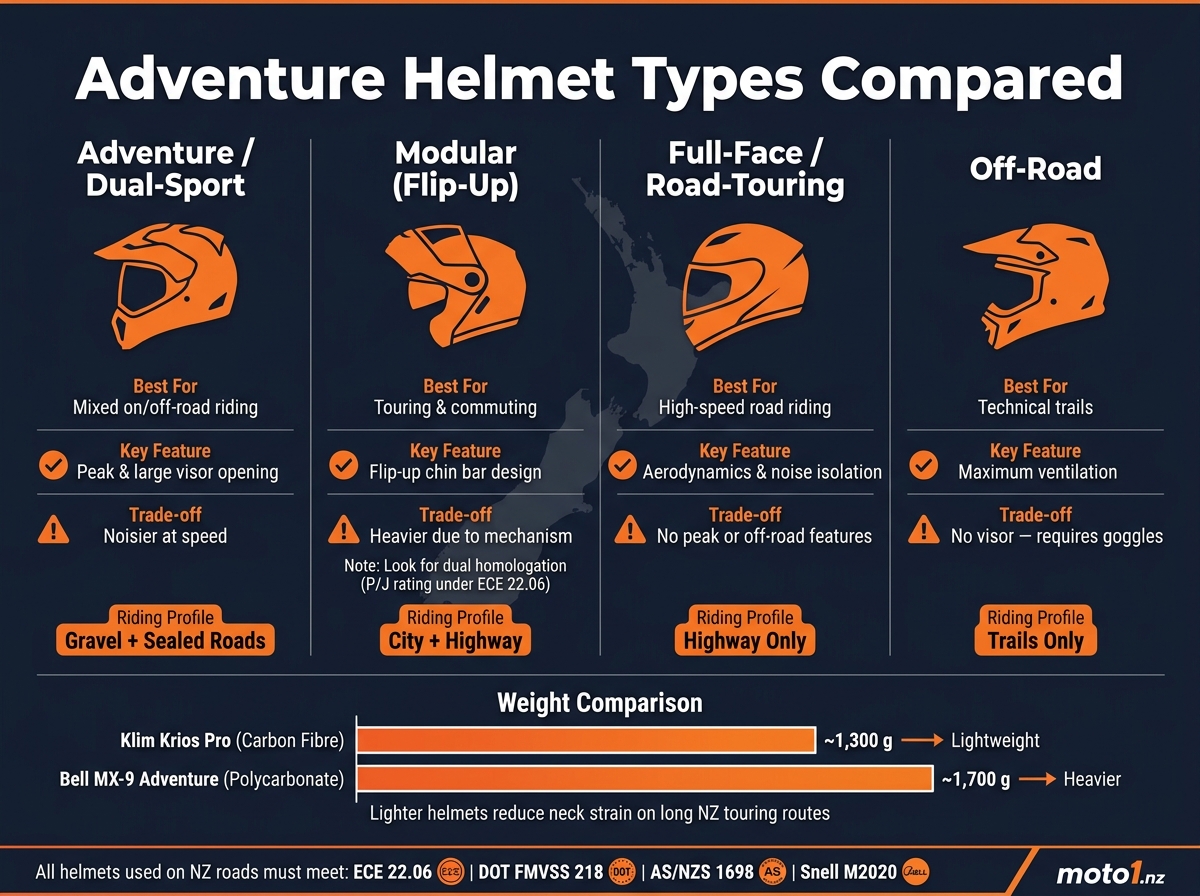
Adventure Helmet Types Compared: Features, Benefits & Trade-offs
Main Adventure Helmet Categories
Adventure helmets come in several styles, each tailored to specific riding conditions. Here's a quick breakdown:
| Helmet Type | Best For | Key Feature | Trade-off |
|---|---|---|---|
| Adventure/Dual-Sport | Mixed on/off-road | Peak & large visor opening | Noisier at speed |
| Modular (Flip-Up) | Touring & commuting | Flip-up design | Heavier due to mechanism |
| Full-Face/Road-Touring | High-speed road riding | Aerodynamics & noise isolation | No peak or off-road features |
| Off-Road | Technical trails | Maximum ventilation | No visor; requires goggles |
The adventure/dual-sport helmet is perfect for New Zealand riders who enjoy both sealed roads and gravel tracks. With its combination of a face shield, peak, and high-flow vents, it’s ideal for the country's diverse landscapes. Modular helmets, on the other hand, cater to those who want full-face protection but also value the convenience of flipping the chin bar up during stops or in traffic. If you plan to ride with the chin bar open, make sure the helmet has a dual homologation rating (P/J under ECE 22.06), ensuring it's tested for safety in both closed and open positions.
Each helmet type brings its own advantages and trade-offs, and understanding these can help you make the right choice for your riding style.
Adventure-Specific Features
Certain features make adventure helmets stand out, especially for the varied conditions found across New Zealand.
- Peak: Designed to shield you from sun glare and flying debris, the peak is particularly useful on off-road trails. However, it can create wind resistance at higher speeds, though this is less of an issue if your bike has a good windscreen.
- Visor Versatility: A large eye port allows goggles to fit comfortably when the visor is raised, which is a bonus for dusty tracks in regions like Marlborough or Central Otago.
- Weight: Lightweight materials like carbon fibre can make a big difference on long rides. For example, the Klim Krios Pro weighs about 1,300 g, significantly lighter than polycarbonate options like the Bell MX-9 Adventure, which weighs around 1,700 g.
- Intercom Compatibility: Modular helmets often come with pre-cut speaker pockets and microphone routing, making Bluetooth setup easier. Adventure helmets might require more effort due to their unique shell shapes.
These features are designed to tackle the challenges of New Zealand's ever-changing weather and mixed riding surfaces, ensuring a safer and more comfortable ride.
Sizing and Fit
Once you've chosen a helmet style, getting the right fit is essential for safety and comfort. Start by measuring your head's circumference at its widest point - just above your eyebrows - with a soft tape measure. Compare this measurement to the manufacturer’s size chart, and try wearing the helmet for 5–10 minutes to check for any pressure points.
Head shape is just as important. For example, Arai helmets are better suited for intermediate-oval to long-oval heads, while Shoei helmets typically fit intermediate-oval shapes. If you're between sizes, look for helmets that come in more shell sizes. The Shoei Hornet ADV, for instance, offers four shell sizes, allowing for a more precise fit.
When the chin strap is fastened, the helmet should fit snugly enough that it moves your skin along with it, rather than sliding around independently. A proper fit not only boosts safety but also enhances overall comfort, especially on long rides.
Choosing the Right Helmet for Your Riding Style
Matching Helmet Choice to Riding Style
Picking the right helmet comes down to how and where you ride. In New Zealand, riders usually fall into three categories: weekend trail adventurers, long-distance tourers, and daily dual-sport commuters.
If your weekends are spent exploring gravel tracks and remote trails - like the iconic Molesworth Station route - a dedicated adventure or dual-sport helmet is ideal. Look for features like a wide eyeport, a removable peak, and compatibility with goggles. For those clocking up kilometres on sealed highways, such as the scenic State Highway 6 in the South Island, modular or full-face helmets are a better fit. These helmets offer aerodynamic designs, built-in sun visors, and excellent noise reduction. If you're a dual-sport commuter tackling both city streets and gravel roads, a mid-range adventure helmet with a flip-up visor and removable peak is a practical choice. Your riding profile is key to identifying which features will serve you best.
Local conditions also play a big role in helmet selection.
New Zealand Riding Conditions and Helmet Features
New Zealand's weather is famously unpredictable. A crisp, sunny morning in Canterbury can quickly turn cold and damp by the afternoon. This makes anti-fog technology a must-have. Helmets equipped with the Pinlock 120 MaxVision insert are a solid choice - just check whether it's included or needs to be purchased separately (these inserts typically range from $60–$130 NZD).
"Pinlock 120 MaxVision insert is included, which is a genuine bonus for NZ conditions where fogging can be an issue in the cooler months." - Paul, Product Reviewer, Bike Rider Magazine
The low-angle sun during autumn and winter afternoons can be blinding, so an internal drop-down sun visor is more of a necessity than a luxury. For riders tackling dusty trails and unsealed roads, a helmet with a wide eyeport that accommodates goggles offers better eye protection. Wind buffeting is another factor to consider, especially on exposed roads and mountain passes. Helmets with wind-tunnel-tested shells and integrated spoilers perform noticeably better in these conditions. When combined with a proper fit and regular maintenance, these features ensure a safer and more comfortable riding experience in New Zealand.
Balancing Budget, Value, and Lifespan
Your budget will also influence your helmet choice. Adventure helmets in New Zealand range widely in price. Entry-level polycarbonate helmets, like the LS2 Pioneer II, start at around $319.99 NZD. Mid-range composite options, such as the Scorpion ADX-2, are priced from approximately $469 NZD. At the premium end, models like the Leatt 8.5 ADV Kit can cost up to $1,399.99 NZD. These higher-end helmets often come with extras like a photochromic visor, clear visor, and Pinlock inserts, adding over $200 NZD in value.
While polycarbonate helmets are more affordable, carbon fibre options are lighter and reduce neck strain on long rides - a big plus for New Zealand's lengthy touring routes. Whatever your choice, ensure the helmet is certified. Road-legal helmets in New Zealand must meet standards like ECE 22.05/22.06, DOT FMVSS 218, or AS/NZS 1698. Retailers like Moto 1 offer a wide selection of certified helmets, making it easy to compare models and find one that fits your needs and budget.
Care, Maintenance, and Replacement
Routine Cleaning and Care
Keeping your helmet clean isn’t just about looking good - it’s about keeping it safe and functional for as long as possible. For the outer shell, stick to mild soap and warm water. Harsh chemicals or solvents? Avoid them. They can weaken the shell and compromise its protective ability. Even stickers can pose a risk; the adhesives might damage the shell, so it’s best to skip them.
The interior liner, which absorbs sweat and oils, needs regular attention. If it’s removable, hand wash it or use a gentle machine cycle (tuck it into a mesh bag) with mild soap. Always air dry it completely before putting it back in. During the summer or after frequent use, clean it more often to keep the foam in good shape. For visors and anti-fog inserts like Pinlock, use a soft, damp cloth - steer clear of anything abrasive that might scratch them.
Storage matters too. Leaving your helmet on a hot car seat or in direct sunlight can speed up wear and tear. Instead, store it in a cool, dry place, ideally in a protective bag. Regular cleaning doesn’t just keep your helmet looking fresh; it also helps you spot early signs of wear or damage.
Handling Wear and Damage
The EPS (Expanded Polystyrene) foam liner is the backbone of your helmet’s safety, but it doesn’t last forever. Over time, exposure to sweat, oils, and UV light causes it to degrade.
"The inner EPS lining develops micro-tears that expand and compromise the helmet's integrity." - Moto1.nz
Even a low-speed drop can damage the EPS liner, even if the outer shell looks fine. If your helmet takes a hit - whether from a crash or a hard knock - replace it immediately, no matter how it appears on the outside. Regular checks are essential: inspect the chin strap, double-D ring, and screws for wear, and make sure everything is secure. To check your helmet’s age, look for the manufacturing date label, usually under the chin strap or behind the ear padding. Staying on top of these checks ensures your helmet stays reliable and safe.
When to Upgrade or Replace Your Helmet
While regular care helps, knowing when to replace your helmet is equally important. The general rule? Replace it every five years or within seven years from the manufacturing date - whichever comes first. If you’re a frequent rider or often ride in tough conditions, you might need to replace it closer to the three-year mark.
"The foam degrades over time and with regular use... helmet manufacturers recommend replacing your helmet every 7 years from the production date or after 5 years of use." - Moto1.nz
Upgrading to a newer helmet also offers access to improved safety features. Helmets certified under ECE 22.06 provide better protection compared to older ECE 22.05 models. Some newer designs include MIPS (Multi-Directional Impact Protection System), which reduces rotational forces during impacts. These features meet the strict safety standards required in New Zealand, ensuring your helmet remains both road-legal and effective.
If you’re looking for comfort, consider switching to a lighter helmet. For example, a carbon fibre shell can significantly reduce neck strain on long rides through New Zealand’s scenic routes. And remember, never buy a used helmet - damage to the EPS liner is often invisible.
Conclusion
When choosing an adventure helmet, focus on certification, fit, and maintenance. In New Zealand, helmets must meet recognised safety standards like ECE 22.05/22.06, DOT FMVSS 218, AS/NZS 1698, or Snell M2020 to be road-legal. Features like MIPS, multi-density EPS liners, and emergency cheek pad releases can provide added protection in a crash. Whether you're navigating gravel trails or city streets, consider ventilation, visor configuration, and shell material to match your riding conditions. A well-chosen helmet delivers dependable performance when properly cared for.
For maintenance, replace your helmet every five years, clean it with mild soap and water, store it in a cool, shaded place, and avoid using any helmet that has sustained a significant impact - even if it looks undamaged.
If you’re planning to upgrade your gear, check out Moto 1 for a wide selection of adventure helmets from top brands like Arai, Shoei, Bell, HJC, LS2, and Just 1. Plus, they offer free shipping on qualifying orders within New Zealand.
FAQs
How do I check if a helmet is road-legal in New Zealand?
To ensure a helmet is road-legal in New Zealand, look for a certification label or sticker confirming it meets approved safety standards such as ECE 22.05, ECE 22.06, DOT FMVSS 218, AS/NZS 1698, or Snell M2020. These certifications are required under New Zealand law. Always double-check for these labels before buying, especially when shopping online, as helmets without proper certification are illegal and could impact your insurance coverage.
Should I choose polycarbonate, fibreglass, or carbon fibre?
When choosing a helmet, consider factors like your budget, weight preference, and safety requirements. Polycarbonate helmets are a cost-effective option but tend to be heavier and less resistant to UV damage. Fibreglass helmets strike a balance with a good strength-to-weight ratio and excellent impact absorption. If you're after something lightweight and durable, carbon fibre helmets are a top choice, though they come with a higher price tag. Whatever you decide, make sure the helmet complies with recognised safety standards such as ECE 22.06, DOT, or AS/NZS 1698.
What fit signs show I’ve chosen the right helmet size?
A properly fitted adventure helmet should sit snugly on your head, evenly distributed without any gaps or unnecessary movement. The cheek pads should feel secure and supportive - firm but not uncomfortable. To ensure the right fit, wear the helmet for about 5–15 minutes. This gives you time to notice any pressure points or discomfort, which could signal that the fit isn't quite right.