

When it comes to motorcycle safety, your tyres are everything. They’re your only connection to the road, handling braking, grip, and cornering. Worn or damaged tyres can double stopping distances, reduce grip, and increase the risk of accidents - especially on New Zealand’s rough chip seal roads, which wear tyres faster than smoother surfaces overseas. Here’s what you need to know:
- Tread Depth: Replace tyres when tread depth is below 3mm for safety. The legal minimum in NZ is 1.5mm, but performance drops significantly before that.
- Age: Tyres older than 10 years must be replaced, regardless of tread. Check the manufacture date using the DOT code on the sidewall.
- Damage: Cracks, bulges, or cuts longer than 25mm require immediate replacement. Sidewall damage cannot be repaired.
- Uneven Wear: Patterns like flat centres or worn edges signal issues like incorrect pressure or alignment that need addressing.
- Rubber Hardening: Even if tread looks fine, tyres over 5 years old may lose grip due to hardening.
Regular checks, proper inflation, and smooth riding can help extend tyre life. If replacement is needed, choose tyres suited to your riding style and conditions. For NZ riders, local suppliers like Moto 1 offer a wide range of options with fast shipping. Keep your tyres in good shape to ensure every ride is safe.
How Motorcycle Tyres Wear and Age
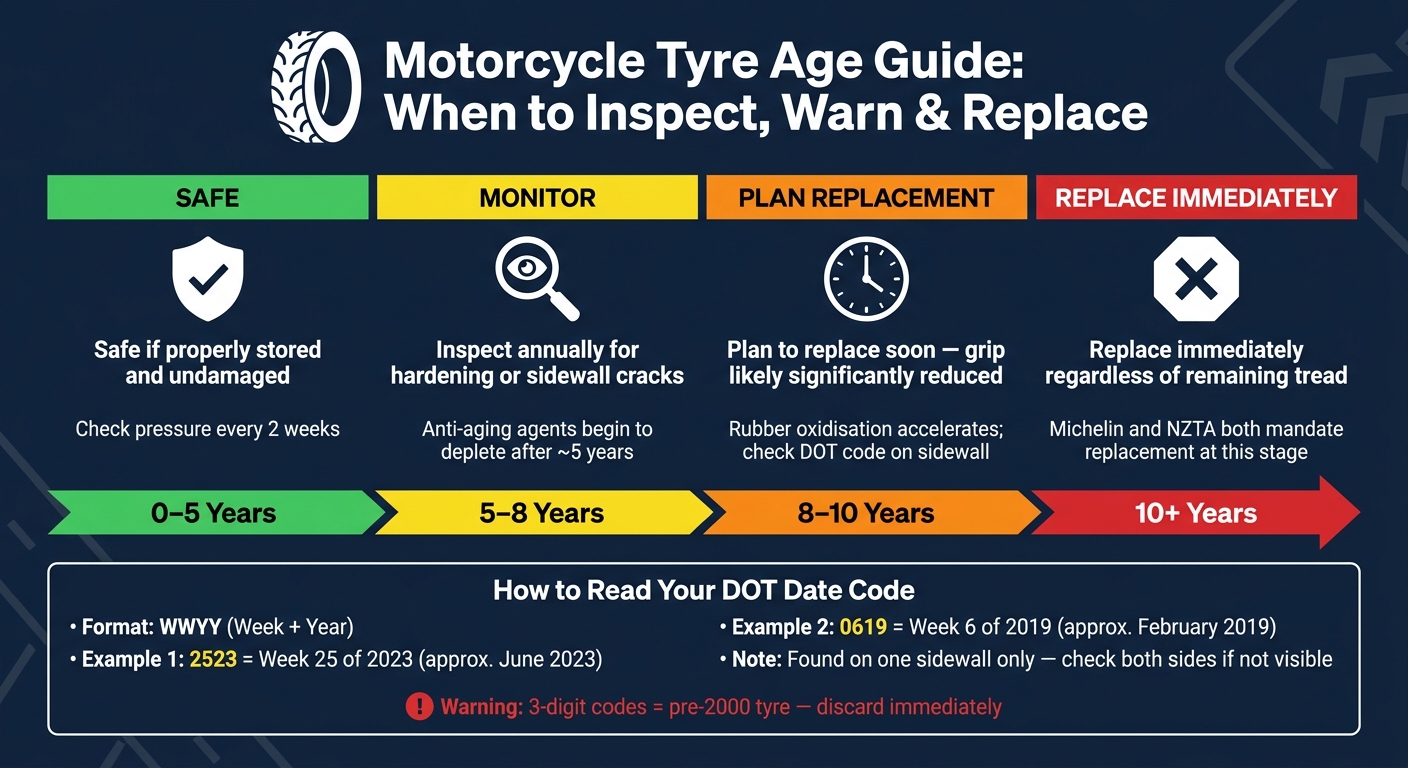
Motorcycle Tyre Age Guide: When to Inspect, Warn & Replace
What Causes Tyre Wear
Motorcycle tyres wear down due to a mix of friction, heat, and chemical processes. Every kilometre ridden scrapes away a tiny layer of rubber. How quickly this happens depends on factors like riding style, tyre pressure, and the type of road and off-road terrain you ride on.
Your riding style can make a big difference. Hard acceleration, sharp braking, and quick cornering can chew through tread much faster than smooth, controlled riding. Tyre pressure is equally crucial. If your tyres are under-inflated, the shoulders wear out too quickly, and internal heat builds up. On the flip side, over-inflation focuses wear on the centre of the tread. New Zealand riders, in particular, may notice faster wear due to the coarse nature of chip seal roads.
Tyres also age chemically over time. Manufacturers add anti-aging agents to the rubber to guard against UV rays and ozone. These agents gradually rise to the surface and wear off, leaving the rubber vulnerable. Typically, this process takes 3 to 5 years, after which the rubber hardens and loses grip, even if the tread depth looks fine.
These combined factors determine how long your tyres stay safe and effective.
How Long Motorcycle Tyres Last
The lifespan of a motorcycle tyre varies widely, influenced by how and where it’s used, as well as how it’s stored. For instance, a rear tyre on a sports bike ridden aggressively might only last 8,000–10,000 km, while a touring tyre on a commuter bike could stretch to 20,000 km or more. Front tyres generally wear out more slowly and often last much longer than rear tyres.
Age is just as critical as mileage. Even if a tyre still has plenty of tread, tyres older than 10 years should always be replaced.
"As a precaution, all tyres that have not been replaced after ten years should be changed, even if they appear to be in a generally good condition." - Michelin
Here’s a handy guide based on tyre age:
| Tyre Age | Recommended Action |
|---|---|
| 0–5 years | Safe if properly stored and undamaged |
| 5–8 years | Inspect annually for signs of hardening or small cracks on the sidewall |
| 8–10 years | Plan to replace soon, as grip will likely be significantly reduced |
| 10+ years | Replace immediately, no matter how much tread remains |
How to Read the Tyre Date Code
Every tyre comes with a DOT code stamped onto its sidewall. At the end of this code, you’ll find a four-digit number that reveals the tyre’s manufacture date. This number follows the WWYY format: the first two digits represent the week, and the last two digits indicate the year.
For example:
- A code of 2523 means the tyre was made in the 25th week of 2023 (around June 2023).
- A code of 0619 indicates the 6th week of 2019 (around February 2019).
Keep in mind that the date code is often printed on just one sidewall, so if you don’t see it on one side, check the other. If you find a tyre with a three-digit date code, it was manufactured before 2000. Such tyres are far beyond their safe lifespan and should be discarded immediately.
sbb-itb-bfda696
Signs Your Tyres Need Replacing
Tread Depth and Legal Minimums
In New Zealand, the legal minimum tread depth for motorcycle tyres is 1.5mm across all principal grooves. Falling below this limit not only risks a $150 fine per tyre and a WoF failure but also greatly increases stopping distances.
"We recommend replacing tyres at 3mm. Below that, wet grip deteriorates rapidly and the risk of aquaplaning increases significantly." - NZ Transport Agency (Waka Kotahi)
To put this into perspective, a new tyre with approximately 8mm of tread can stop in about 25 metres on a wet road at 80 km/h. However, a tyre worn down to the legal limit might need almost 50 metres to stop.
For a quick check, use a NZ 20¢ coin. If the full "20" is visible in the groove, the tread is below 3mm, and it's time to replace the tyre. For a more precise measurement, a basic tread depth gauge costs between $5 and $10. Additionally, most modern tyres come with Tread Wear Indicators (TWI), which are small raised bars inside the grooves. When the tread becomes level with these bars, the tyre has reached its legal limit.
"Once the remaining rubber has worn down to this level [TWI], the tyre has reached or exceeded its legal wear limit... your safety cannot be guaranteed, nor can grip or performance, particularly on wet surfaces." - Michelin
Uneven Wear Patterns
Uneven wear patterns on tyres can point to underlying problems like incorrect tyre pressure, suspension issues, or misaligned wheels. The table below highlights common wear patterns, their causes, and suggested actions:
| Wear Pattern | Likely Cause | Recommended Action |
|---|---|---|
| Centre worn, edges fine | Over-inflation | Reduce pressure; check tread depth |
| Both edges worn, centre fine | Under-inflation | Increase pressure; inspect for damage |
| One edge worn | Wheel misalignment | Seek a professional wheel alignment |
| Cupping or scalloping | Worn suspension | Inspect shocks and suspension components |
A squared-off rear tyre - where the tyre's profile becomes flat instead of rounded - is another sign that replacement is needed. This often occurs on bikes ridden mostly in an upright position, leading to vague handling and reduced steering precision.
Cracks, Bulges, and Physical Damage
Physical damage can severely compromise tyre safety. Bulges or lumps on the tyre surface indicate internal structural failure and require immediate replacement. Cuts longer than 25mm that reach or expose the cords result in an automatic WoF failure. Embedded objects like nails or glass also weaken the tyre and should be assessed by a professional.
"As a general rule, don't ride on damaged or flat tyres." - Michelin
Sidewall damage is particularly concerning. Unlike tread punctures, sidewall damage cannot be repaired. Any visible cuts, cracks, or deformations along the sidewall mean the tyre should be replaced right away.
Age-Related Rubber Hardening
Even tyres that appear fine on the outside can become unsafe due to ageing. Over time, rubber oxidises and hardens, reducing flexibility and grip, even if the bike hasn’t been used much.
"Consider a tyre's effective lifespan to be around five years even if tread remains." - Ride Forever NZ
Look out for fine cracks on the sidewall or within the tread grooves, as these indicate that the rubber is breaking down. UV exposure can speed up this process, so storing tyres properly is essential. If you notice visible cracks or signs of hardening, have the tyre inspected by a professional and replaced if necessary.
Deciding When and How to Replace Your Tyres
Assessing Multiple Wear Factors Together
When it's time to evaluate your tyres, consider several wear indicators together: tread depth, physical condition, and age. If the tread is under 3mm, there’s visible damage, or the manufacture date exceeds six years, it’s time for a closer inspection. If you spot two or more of these issues, replacement becomes urgent. And remember, tyres should never be used beyond 10 years from their manufacture date, no matter how good they look.
Once you’ve determined that replacement is necessary, the next step is choosing tyres that fit your riding needs.
Matching Tyre Choice to Your Riding Style
The right tyres can make a huge difference in both safety and performance. Your choice should reflect the type of riding you do. New Zealand’s diverse roads - whether urban, highway, off-road, or track - call for tyres with specific features.
| Riding Scenario | Key Tyre Feature | Product |
|---|---|---|
| City commuting | Fast warm-up, durability, wet grip | Michelin Road 6 (NZ$268–NZ$416) |
| Highway touring | High mileage, stability, comfort | Metzeler ME 880 Marathon |
| Off-road adventure | Aggressive tread, cut resistance | Mitas E09 Dakar (NZ$259) |
| Track / sport | Maximum contact patch, multi-compound | Pirelli Diablo Supercorsa SC V3 (NZ$319) |
For adventure riders who navigate both sealed roads and gravel, the terrain ratio is a helpful guide. For example, the Mitas E09 is designed for 20% road use and 80% off-road use. Additionally, ensure any replacement tyre complies with WoF (Warrant of Fitness) requirements. This means the tyre must match the size, carcass type (radial or bias-ply), and tread pattern of the tyre on the same axle. Avoid using tyres marked "NHS" (Not for Highway Service) or "Racing Purposes Only" on public roads.
Where to Buy Replacement Tyres in New Zealand
For high-quality tyres that meet New Zealand’s standards, Moto 1 is a reliable option. They stock over 1,800 tyre models from top brands like Michelin, Pirelli, Dunlop, Bridgestone, Continental, and Maxxis. Orders over NZ$149 qualify for free shipping across the country, with most products dispatched within one to two business days from local warehouses. Plus, they offer a 90-day return policy for unused tyres still in their original packaging.
How to Make Your New Tyres Last Longer
Checking Tyre Pressure Regularly
Taking care of your tyres not only extends their lifespan but also ensures you get the best performance out of them. One of the simplest yet most effective maintenance habits is keeping your tyres at the correct pressure.
Always check tyre pressure when the tyres are cold - after the bike has been stationary for at least two to three hours or ridden less than 3 km at a gentle pace. Checking pressure after riding can give inaccurate, higher readings, and releasing air from a hot tyre can result in dangerous under-inflation once the tyre cools.
Stick to the recommended PSI listed in your owner's manual or on the frame sticker. Avoid using the maximum PSI printed on the tyre’s sidewall, as that's the upper limit, not the ideal pressure for everyday use. Michelin advises checking tyre pressure every two weeks and before long rides. A reliable digital gauge is a smart investment, as some garage compressors may introduce moisture, leading to fluctuating pressure due to temperature changes.
"Check your motorcycle tyre pressure often when the tyre is COLD. Michelin recommends checking the tyre pressure every two weeks and during long rides." - Michelin
If you’re carrying extra weight, such as a pillion passenger or heavy luggage, adjust the rear tyre pressure accordingly - about 0.2 bar (roughly 2.9 PSI) higher. And remember, in New Zealand, tyres that are significantly under- or over-inflated can lead to a failed WoF inspection.
Routine Inspections and Alignment Checks
Beyond pressure, keeping an eye on wheel alignment and chain tension is crucial for tyre health. Misaligned chains can cause uneven tyre wear, which increases the need for premature replacements. A 2018 Motor Cycle News survey revealed that 42% of riders don’t regularly check chain tension and alignment - a habit that quietly eats away at tyre life.
Suspension health also plays a role. If your bike bounces more than once after hitting a bump or makes clunking noises, it’s time to have the shock absorbers checked. Worn suspension can cause tyres to lose consistent contact with the road, leading to uneven tread wear. As the NZ Transport Agency Waka Kotahi states: "If the wear is uneven, have the wheels balanced and alignment checked."
Pairing these mechanical checks with smooth riding habits is a winning formula for extending tyre life.
Smooth Braking and Acceleration Habits
How you ride has a direct impact on how long your tyres last. Gradual braking and smooth acceleration help reduce the heat caused by friction, which is a major contributor to tyre wear. Sudden stops and aggressive throttle use can lead to flat spots and uneven tread stripping.
New tyres also need a break-in period. Freshly manufactured tyres often have a slick coating of release agent that can make them slippery. For the first 50 to 100 km, ride cautiously, avoiding sharp lean angles and hard braking, to allow the tyres to scrub in and achieve optimal grip.
"The key to a long life is to maneuver in a gentle, gradual manner." - Honda Global
Once your tyres are broken in, maintaining a steady and measured riding style pays off. Touring tyres, when used gently, can last between 15,000 and 25,000 km. However, aggressive riding can drastically shorten their lifespan.
Conclusion: Keep Your Tyres Safe and Road-Ready
Your tyres are the only part of your bike that touches the road, and their condition plays a huge role in your safety. Worn tyres can double stopping distances and significantly increase the risk of accidents. Fortunately, maintaining them doesn’t take much effort. Regularly check the tread depth, the DOT manufacturing date, and tyre pressure. Keeping an eye on these factors - along with ensuring your tyres suit your riding style - helps make every ride safer.
As NZTA Waka Kotahi advises:
"We recommend replacing tyres at 3mm. Below that, wet grip deteriorates rapidly and the risk of aquaplaning increases significantly."
This highlights the importance of choosing the right tyres for your needs. Whether you’re into road riding, adventure trips, or motocross, Moto 1 offers a wide selection of tyres from trusted brands like Michelin, Pirelli, Bridgestone, and Dunlop. They even provide free shipping on orders over $150 and dispatch orders within 1–2 business days straight from their New Zealand warehouse.
Invest in reliable tyres and make every ride a safe one.
FAQs
How do I tell if my tyre has hardened, not just worn?
Over time, tyres can harden and lose their grip, even if the tread appears to be in good condition. This happens because the rubber dries out, often becoming brittle or developing cracks along the sidewalls. However, hardening isn’t always something you can see. That’s why age plays a crucial role - experts suggest replacing tyres every five years to ensure they perform reliably, no matter how much wear they show.
Can I repair a puncture, or do I need a new tyre?
When it comes to tyre punctures, whether a repair is possible depends on the extent and location of the damage. It's essential to have a professional inspect the tyre to ensure it's safe to fix. Temporary repair kits can be handy for getting you to a workshop, but they're not meant as a long-term solution.
Repairs are generally limited to small punctures located in the tread area. However, if the damage involves the sidewall or shoulder, if cords are exposed, the tyre is excessively worn, or the puncture is too large, replacement is the safer option.
What tyre should I choose for my type of riding in NZ?
Choosing the right tyre for your motorcycle hinges on three key factors: your bike type, how you ride, and the terrain you tackle. If you're commuting or touring around New Zealand, sport-touring tyres are a solid pick. They’re built to last and deliver reliable grip, even in wet conditions. Prefer spirited rides on dry roads? Sport tyres offer superb handling and traction, though they tend to wear out quicker. For those venturing onto gravel roads or exploring the backcountry, adventure tyres are the way to go. At Moto 1, you’ll find a wide selection of tyres tailored to your riding style and needs.