

Choosing the right tyres for your motorcycle is crucial for safety, performance, and cost-efficiency - especially in New Zealand, where roads can shift from smooth tarmac to gravel in minutes. Here's what you need to know:
- Off-road tyres: Designed for grip on loose surfaces like mud, sand, and gravel. They have deep, knobby treads and reinforced sidewalls but struggle on sealed roads with reduced grip, noise, and faster wear.
- Road tyres: Optimised for tarmac with smoother tread patterns and better braking, cornering, and durability. However, they perform poorly off-road, offering minimal traction on loose terrain.
- Key trade-offs: Off-road tyres are better for rugged trails but wear quickly on tarmac, while road tyres excel on sealed surfaces but are vulnerable off-road.
Quick Tip: For mixed riding, consider dual-purpose adventure tyres, which balance performance across both terrains.
Whether you're navigating New Zealand's chip-seal roads or venturing into backcountry trails, matching your tyres to your riding conditions is essential for safety and longevity.
Off-Road Tyres: Design and Performance
Key Design Features
Off-road tyres are all about grip in tricky conditions. Instead of relying on smooth contact with the ground like road tyres, they use large, chunky rubber blocks - often referred to as knobs - that dig into loose surfaces for traction. Equally important are the spaces between these knobs, known as the void ratio. These gaps allow mud, stones, and debris to be flung out as the tyre spins, keeping the tread clear and ready to grip again.
The sidewalls of off-road tyres are built tougher than those on road tyres. They often feature multiple reinforcing plies to ward off punctures from sharp rocks and prevent pinch flats. Inside, the tyre's carcass is designed to be more flexible, so it can mould around uneven surfaces like rocks or roots. This flexibility increases the tyre’s contact with the ground, where a stiffer tyre might just bounce off. These features are what make off-road tyres perform so well in rugged environments.
Performance in Off-Road Conditions
Off-road tyres shine when the going gets rough. In muddy conditions, the knobs act like paddles, propelling the bike forward where a road tyre would just spin uselessly. On sandy terrain, a wider tyre and lower pressure help spread the bike’s weight, preventing it from sinking. On gravel or rocky tracks - like those found in the South Island’s backcountry - the deep tread and reinforced construction absorb impacts that would likely damage standard road tyres.
For riders in New Zealand, picking the right tyre for the terrain can make a big difference. Hard terrain tyres are ideal for rocky trails, while soft terrain tyres are better suited for muddy or sandy areas, such as coastal tracks. However, these off-road advantages come with some drawbacks when riding on sealed roads.
Limitations on Sealed Roads
The same features that make off-road tyres excel on rough terrain can be a disadvantage on the road. Because only the tips of the knobs make contact with the tarmac, the effective contact patch is much smaller than that of a road tyre. This results in longer braking distances and less stability when cornering. At higher road speeds, the knobs can flex too much, generating heat that may cause knob tearing or even damage the tyre carcass during extended use.
Another issue is the noise. The rapid compression of air gaps in the tread creates a noticeable hum, which can be distracting. Additionally, New Zealand’s chip-seal roads can cause faster tread wear, and riders may experience "chunking", where pieces of the tread break off. This not only reduces the tyre’s lifespan but also impacts its off-road performance when you need it most.
sbb-itb-bfda696
Road Tyres: Design and Performance
Key Design Features
Road tyres are all about maintaining maximum contact with the road surface. Instead of using chunky knobs like off-road tyres, they feature shallow, continuous tread patterns with narrow sipes. These small grooves help channel water away, reducing the risk of aquaplaning. The harder rubber compound used in road tyres is both heat-resistant and durable, ensuring they maintain their shape at high speeds and last longer on tarmac.
Most modern road motorcycle tyres are built with radial construction, where the fabric cords run at 90 degrees to the direction of travel. This design helps tyres stay cooler at higher speeds and provides better grip and stability compared to older bias-ply designs. Depending on the rider’s needs, road tyres come in different types:
- Sport tyres: These prioritise dry-weather grip with softer rubber but wear out faster.
- Touring tyres: A balanced option, offering reliable grip and durability in both wet and dry conditions.
- Dual-compound tyres: These combine softer rubber on the edges for cornering with harder rubber in the centre for greater mileage.
Performance on Sealed Roads
Road tyres excel on tarmac, delivering the performance they’re designed for. Their uninterrupted contact patch ensures more rubber meets the road, which means shorter braking distances, confident cornering, and predictable handling. On New Zealand’s mix of smooth city roads and coarse chip-seal highways, a good touring or sport-touring tyre provides both stability and comfort.
New Zealand’s road surfaces can be quite varied. As Gareth Morgan, Head of Operation Delivery at Selwyn District Council, points out:
"Although our sealed roads are smoother than our peers, the road surface is trending downwards as our roads age, and as our roads cater for the growth and increased traffic."
For Kiwi riders covering long distances across diverse conditions, a dual-compound touring tyre is often the best choice. It offers reliable grip on wet corners without compromising tread life on long highway stretches. However, when the journey takes you off sealed roads, these benefits start to fade.
Limitations Off-Road
Off-road, road tyres quickly lose their effectiveness. Their shallow tread pattern doesn't provide the grip needed for loose surfaces like gravel, sand, or mud. In muddy conditions, the narrow sipes clog up almost instantly, turning the tyre into a slick with minimal traction.
Road tyres also have thinner sidewalls compared to off-road tyres, making them more vulnerable to sharp rocks and rough gravel often found on New Zealand’s backcountry tracks. Lowering tyre pressure for better grip - a common off-road trick - isn’t ideal for road tyres. It increases the risk of pinch flats and rim damage, as the sidewalls aren’t designed to handle such stress. The stiff carcass further complicates things by bouncing off obstacles instead of conforming to uneven terrain, reducing control and adding strain to the tyre structure.
For riders who occasionally encounter gravel roads during their travels, a 90/10 road-biased tyre can be a practical compromise. This type of tyre offers slightly wider tread voids for improved grip on loose surfaces, while avoiding the noise and faster wear of a full off-road tyre.
Off-Road vs. Road Tyres: Side-by-Side Comparison
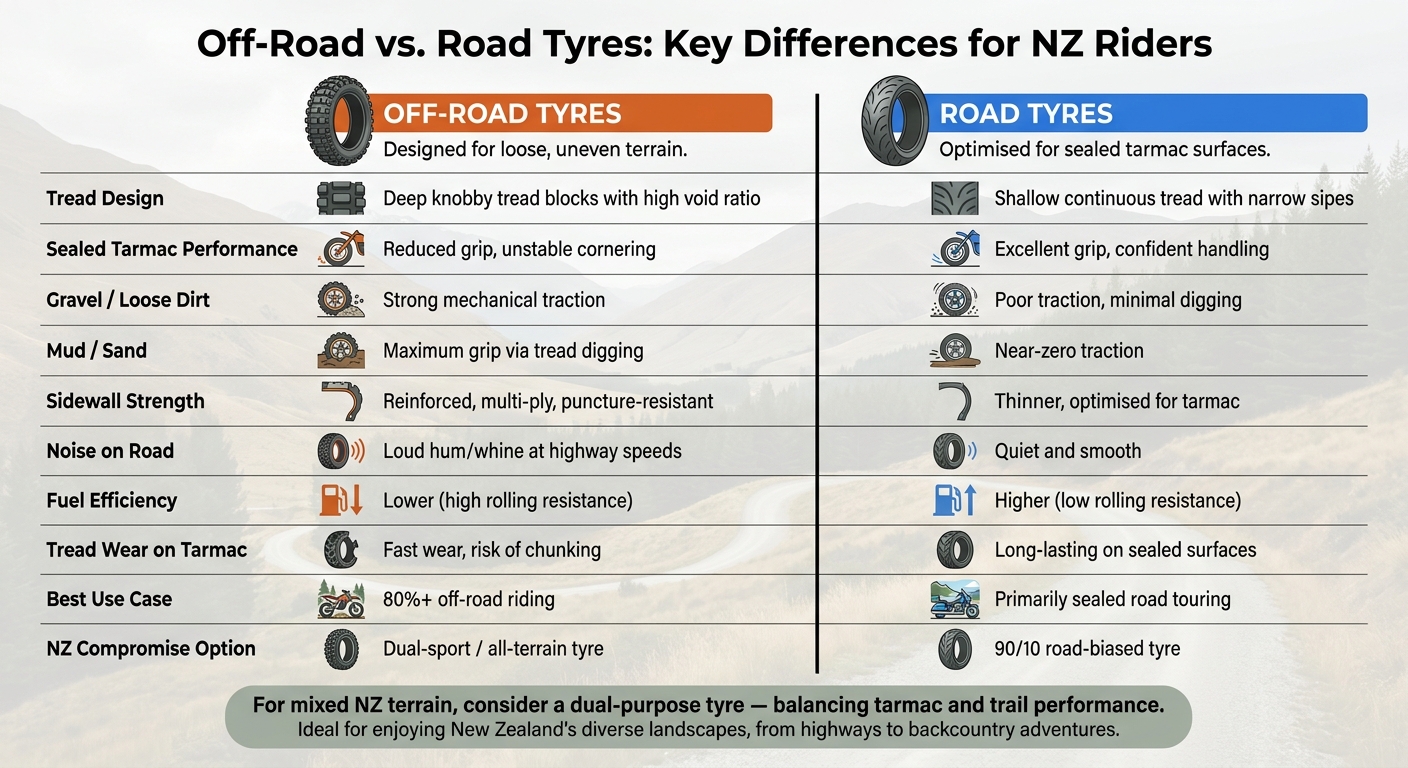
Off-Road vs. Road Tyres: Side-by-Side Comparison for NZ Riders
Traction and Handling
The way tyres grip the ground is all about design. Off-road tyres are built to dig into loose surfaces - their deep knobs act like cleats, gripping mud, sand, and gravel to keep the bike moving forward. Road tyres, on the other hand, rely on a large, smooth contact patch to grip sealed tarmac through rolling friction.
When used on the wrong surface, both types struggle. Off-road tyres on asphalt lose much of their contact patch, resulting in imprecise handling. This is especially noticeable in corners, where the knobs flex under pressure instead of holding firm. Meanwhile, road tyres on loose terrain can't dig in, leaving riders with minimal control.
| Surface | Off-Road Tyres | Road Tyres |
|---|---|---|
| Sealed tarmac | Reduced grip, unstable cornering | Excellent grip, confident handling |
| Gravel / loose dirt | Strong mechanical traction | Poor traction, minimal digging |
| Mud / sand | Maximum grip via tread digging | Near-zero traction |
As shown in the table, each tyre type excels only on its intended surface. For New Zealand riders, where terrain can shift from tarmac to gravel in minutes, this is a crucial factor to consider. Next, let’s look at how these tyres hold up over time.
Durability and Wear
Road tyres are designed to handle sealed surfaces for the long haul. They use harder rubber compounds - sometimes dual-compound designs - to withstand the abrasive nature of New Zealand's chip-seal roads. Off-road tyres, however, are made with softer rubber and tall tread blocks, which excel on soft terrain but wear down quickly on tarmac.
Durability isn’t the only difference. The rider’s experience changes too.
On rough gravel tracks, road tyres with thinner sidewalls and shallower tread are more prone to cuts and pinch flats. Off-road tyres, with their robust construction, offer better protection against sharp rocks and other hazards.
Comfort, Noise, and Fuel Use
The riding experience on sealed roads is noticeably different depending on the tyre type. Road tyres are smooth and quiet, designed to reduce noise and vibration on tarmac. Off-road tyres, however, create a distinct hum or whine at highway speeds as air gets compressed between the large tread blocks. On New Zealand’s chip-seal roads, this noise becomes even more pronounced due to the coarser surface.
Fuel efficiency is another key difference. Road tyres have low rolling resistance, making them more energy-efficient. Off-road tyres, with their tall knobs, lose energy as the tread flexes on hard surfaces. This increased fuel consumption can add up quickly for Kiwi riders covering long distances on the open road.
Choosing the Right Tyres for New Zealand Riding
Assessing Your Riding Needs
Think about how you divide your riding time - sealed roads versus off-road surfaces. Many riders tend to overestimate how much time they spend off-road.
If your riding is mostly on tarmac with the occasional gravel stretch, an 80% on-road / 20% off-road tyre is usually the best choice for highway or touring use. On the other hand, if you regularly switch between sealed and unsealed roads, an adventure or all-terrain tyre might be more suitable. A dedicated off-road tyre should only be considered if you're spending at least 80% of your time off-road.
New Zealand’s diverse terrain makes tyre choice especially important. A ride in Queenstown might start on smooth tarmac but quickly lead to gravel forestry roads. So, focus on what type of terrain you encounter most often.
Once you’ve assessed your riding habits, it’s time to look at the key factors that affect tyre performance in New Zealand.
Tyre Selection Factors
Make sure your tyres match your motorcycle’s specifications. Pay attention to the correct width, aspect ratio, and speed rating. For example, swapping a 120/70ZR17 front tyre on a sport bike for a different size can impact handling. Also, mixing radial and bias-ply tyres is both unsafe and illegal in New Zealand.
New Zealand’s chip-seal roads are rougher than the smoother asphalt found abroad, which can cause tyres to wear out faster. Considering wear rates can help you make a more cost-effective choice.
Keep in mind that tread depth is a legal requirement. New Zealand law requires at least 1.5 mm of tread across the central three-quarters of the tyre. Even if the tread meets this requirement, tyres older than five years should be replaced because the rubber hardens over time, reducing grip.
With these factors in mind, explore the tyre options available at Moto 1, tailored specifically for New Zealand’s unique riding conditions.
Tyre Options at Moto 1
Moto 1 offers a wide selection of tyres to suit different riding styles, from road and sport-touring to adventure and off-road options.
For riders who frequently switch between sealed roads and off-road trails, DOT-approved dual-purpose tyres provide balanced performance on both surfaces. The Pirelli MT 21 Rallycross (NZ$155.00–NZ$214.90) is a great option, rated 90% off-road and 10% street. It’s ideal for gravel, desert, and dirt tracks while remaining road-legal. Another choice is the Motoz Tractionator Enduro S/T (NZ$139.95), made with a hybrid natural/synthetic compound that offers solid grip on asphalt. Its reversible tread design lets you flip the tyre to extend its lifespan. For tougher terrains like clay and rocky paths, the Pirelli Scorpion XC Mid Hard (NZ$184.90–NZ$219.90) is a heavy-duty, road-legal tyre that’s perfect for cross-country enduro riding while still performing well on sealed roads.
"The benefits of a good hybrid tyre outweigh the downsides in my opinion." - Daniel Wylie, Writer, Overland New Zealand
Moto 1 also offers free shipping on orders over NZ$199, with delivery to urban areas typically taking 1–3 days. These tyre options are designed to handle New Zealand’s varied riding conditions, giving you the confidence to tackle any terrain.
Conclusion
When it comes to tyre performance, durability, and noise, your choice should align with the surfaces you ride on most frequently. Road tyres are ideal for sealed roads, offering a quieter ride, better fuel efficiency, and longer lifespan under highway conditions. On the other hand, off-road tyres are built for loose, rugged terrains, but their aggressive tread patterns and softer rubber compounds tend to wear out faster on sealed roads.
"M/T (Mud-Terrain) tyres often offer even less grip on the tarmac than badly worn normal road tyres." - NZ4WD Magazine
This is why many New Zealand riders lean towards all-terrain options. With our roads often shifting from smooth highways to gravel tracks in a matter of minutes, all-terrain or dual-sport tyres provide a practical compromise. They balance the needs of both tarmac and off-road conditions without the significant trade-offs of using off-road tyres on sealed surfaces.
FAQs
How do I choose the right on-road/off-road tyre split for my riding?
To pick the best tyre split, think about your riding habits and the type of terrain you usually encounter. Off-road tyres are designed with deep, aggressive treads to handle dirt and uneven ground. On the other hand, road tyres are built to deliver grip and stability on paved surfaces. If your rides take you across both terrains, dual-sport tyres provide a middle ground. Prioritise the terrain you ride on most often to maintain safety, improve performance, and extend the life of your tyres.
Can I run off-road tyres on chip-seal highways safely?
Using off-road tyres on chip-seal highways is usually not a good idea. These tyres are built for rough, uneven terrain and feature deep treads with aggressive patterns. While great for off-road adventures, they can compromise grip and stability on smooth, sealed surfaces like chip-seal roads. This reduced traction and control can heighten the chances of accidents. For chip-seal highways, sticking with road tyres is a much safer and more practical choice.
What tyre pressure should I use for gravel without risking damage?
For gravel riding, it's all about finding the right tyre pressure that offers a mix of grip, comfort, and protection. Off-road tyres usually perform better at lower pressures, typically in the range of 20–30 psi (1.4–2.1 bar). This helps improve traction and cushions you from bumps and shocks. However, don't let the pressure drop too low, as it can lead to pinch flats. A good baseline is often around 25 psi (1.7 bar), but you'll want to fine-tune it based on your weight, the width of your tyres, and the type of terrain you're tackling.