

Choosing between full-face and modular helmets comes down to safety, comfort, and convenience. Full-face helmets offer stronger protection, especially for the chin area, which accounts for 35% of crash impacts. They're lighter, quieter, and better for high-speed or long-distance riding. Modular helmets, while slightly heavier and less secure due to their hinges, excel in everyday practicality. The flip-up chin bar makes them ideal for urban commutes, touring, or riders who wear glasses. Both types meet New Zealand safety standards, but only full-face helmets can achieve Snell certification for maximum safety.
Quick Comparison
| Feature | Full-Face Helmet | Modular Helmet |
|---|---|---|
| Safety | Maximum protection | High, but hinge weakens structure |
| Weight | Lighter | Heavier due to hinges |
| Noise | Quieter | Louder due to design gaps |
| Convenience | Less practical | Flip-up design for easy use |
| Safety Certifications | Snell, DOT, ECE 22.06 | DOT, ECE 22.06 (No Snell) |
Key takeaway: If safety and performance are your top priorities, go for a full-face helmet. If convenience and flexibility matter more, a modular helmet might suit your needs better.
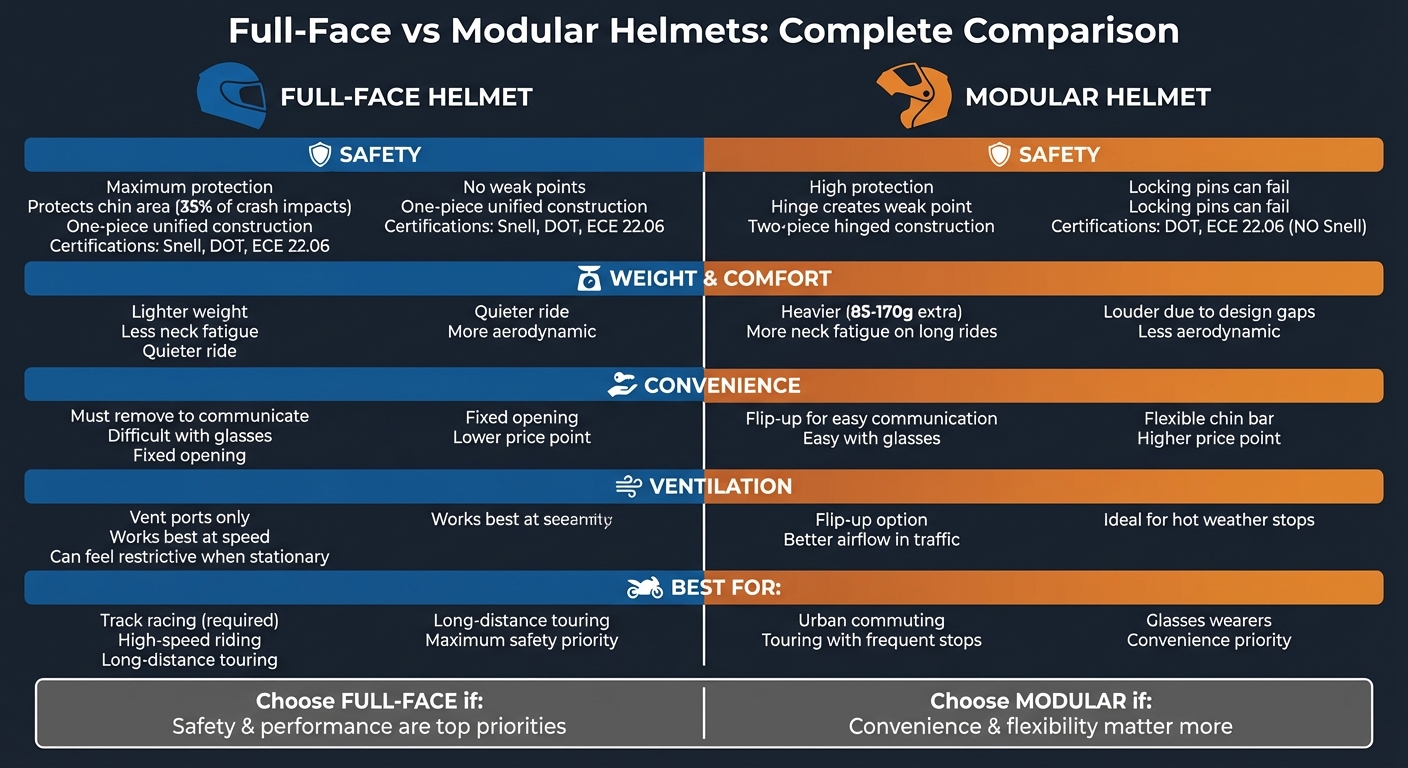
Full-Face vs Modular Motorcycle Helmets Comparison Chart
Full Face Helmets vs. Modular Helmets | Versus
sbb-itb-bfda696
Main Differences Between Full-Face and Modular Helmets
Understanding the contrasts between full-face and modular helmets can help you make a more informed choice based on your priorities - whether that's safety, comfort, or practicality.
Safety and Structural Design
The key difference lies in how these helmets are built. Full-face helmets feature a solid, one-piece shell with a fixed chin bar, providing maximum rigidity. Modular helmets, on the other hand, have a hinged design with locking pins, which introduces potential weak points.
"A modular helmet has a separate chin bar that attaches to the main shell via two hinges and two locking pins... this rotating chin bar creates a weak point in the overall shell design." - MotorcycleGear101
Another factor to consider is the internal structure. Modular helmets often have recessed hardware that can thin the EPS liner around the temples, and some models use polystyrene for the chin bar, which may not perform as well during high-energy impacts. While modern modular designs include metal-reinforced locking points to secure the chin bar during a crash, there are cases where these mechanisms fail to hold under real-world conditions.
There's also a notable difference in safety certifications. No modular helmet has achieved Snell certification to date. This is because modular designs don't meet the chin bar integrity standards required for Snell approval. Both helmet types generally meet DOT and ECE 22.06 standards, but if you're considering a modular helmet, look for P/J homologation (Dual Homologation), which certifies it for use in both closed and open positions.
| Feature | Full-Face Helmet | Modular Helmet |
|---|---|---|
| Shell Design | One-piece unified construction | Two-piece hinged construction |
| Safety Certifications | DOT, ECE 22.06, Snell | DOT, ECE 22.06 (No Snell) |
| Weight | Generally lighter | Heavier due to hinges and hardware |
| Impact Protection | Maximum; no moving parts to fail | High; hinge introduces a weak point |
| Chin Bar Material | Integrated composite/fibreglass | Sometimes polystyrene plastic |
These design differences also influence comfort and airflow, especially on longer rides.
Comfort and Airflow
For long rides, weight and fatigue are crucial considerations. Full-face helmets are typically lighter due to their simpler construction, which can reduce neck strain on extended trips. Modular helmets, however, are heavier because of their flip-up mechanisms and additional features like internal sun visors, which may lead to more fatigue over time.
When it comes to airflow, modular helmets offer more flexibility. You can flip up the chin bar when stationary or during short stops, which is especially helpful in hot weather. Full-face helmets rely on vent ports for airflow, which work well at higher speeds but can feel restrictive when you're not moving. Additionally, full-face helmets tend to be quieter and more aerodynamic, offering a smoother ride with less wind noise and strain at high speeds.
Comfort aside, the practical features of these helmets can also make a big difference in daily use.
Convenience and Flexibility
Modular helmets shine when it comes to everyday convenience. The flip-up chin bar makes it easy to chat at petrol stations, grab a quick sip of water, or talk to passengers without removing the helmet entirely. This feature is particularly popular among touring riders and couriers who value quick and easy communication.
"A full-face helmet can often seem quite intimidating; in a situation where you need to talk to someone, you can flip it [a modular] up, and they can see your face." - MotorcycleGear101
The hinged design also simplifies wearing and removing the helmet compared to the fixed opening of a full-face helmet. However, full-face helmets are generally less expensive than modular ones of similar quality, thanks to their simpler design.
When it comes to integrating Bluetooth motorcycle intercom systems, full-face helmets usually use a fixed wired microphone attached to the chin bar. Modular helmets, however, require a boom or hybrid microphone to accommodate the raised chin bar.
It's worth noting that riding with the chin bar open at high speeds is not advisable. The wind can destabilise the helmet, potentially causing it to dislodge.
Full-Face Helmets: Pros and Cons
Let's break down the advantages and disadvantages of full-face helmets.
Benefits of Full-Face Helmets
The biggest advantage? Protection. Full-face helmets provide unmatched safety, particularly for the chin area, which accounts for up to 35% of crash impacts. The integrated chin bar, crafted from tough materials like fibreglass or carbon fibre, offers dependable protection without relying on hinges or locking pins.
"The chin bar on full face helmets offers unrivalled chin protection, and this increased protection means these kinds of helmets are usually a requirement for track racing." – FlowRacers
Another plus is their lightweight, streamlined design. These helmets are built for aerodynamics, reducing both wind noise and neck strain on long rides. This makes them perfect for high-speed riding, long-distance touring, and even track racing - where track day helmets are often mandatory. For riders navigating New Zealand's highways or urban streets, these features are a big win.
Additionally, only full-face helmets can achieve Snell certification, a recognised safety standard.
While the safety and comfort benefits are clear, there are some trade-offs to consider.
Drawbacks of Full-Face Helmets
One common downside is restricted airflow. Full-face helmets rely on vent ports for ventilation, which work best when you're moving. In hot weather, this can leave you feeling sweaty and uncomfortable.
Another issue is visor fogging, especially in cold or rainy conditions. A good solution is to look for helmets that are Pinlock-compatible, as the internal lens creates an insulating air chamber to prevent condensation.
If you wear glasses, getting the helmet on and off can be tricky. The fixed opening can make it hard to slide the helmet over your spectacles, and some models may not provide enough space for them. It’s a good idea to try on different helmets to ensure a snug fit that doesn’t press your glasses uncomfortably against your temples.
Lastly, there’s the matter of convenience. Simple tasks like grabbing a drink, chatting at a service station, or speaking with a passenger require you to take the helmet off entirely. Some riders also mention feeling claustrophobic due to the fully enclosed design.
So, while full-face helmets are a top choice for safety and performance, they may not suit every rider's needs or preferences.
Modular Helmets: Pros and Cons
Modular helmets bring a level of convenience that many riders appreciate, but their design also introduces some trade-offs.
Benefits of Modular Helmets
Convenience is the standout feature of modular helmets, particularly for urban riders. These helmets allow bikers to communicate easily or take a quick break without fully removing their helmet.
"Modular helmets were created to allow for an increase in comfort and convenience for bikers wanting to communicate or stop somewhere without removing their entire helmet." – Moto1.nz
Their design also offers better airflow, which is a blessing during stop-and-go traffic, especially on warmer days in places like Auckland. For riders who wear glasses, modular helmets are a game-changer, as they make putting on and taking off the helmet much simpler - ideal for those who might feel confined in a fully enclosed helmet.
While these advantages make modular helmets appealing, they come with some compromises.
Drawbacks of Modular Helmets
The flip-up mechanism that makes modular helmets so convenient also introduces some structural vulnerabilities. The hinge and latch system creates a weak point in the helmet's overall design compared to the solid construction of a full-face helmet. In a crash, there’s a risk that the locking pins could fail or that the chin bar might detach entirely.
"This rotating chin bar creates a weak point in the overall shell design, and there's an increased risk of the hinge system opening during the strong impact of a crash." – Keith Mallinson, Motorcycle Enthusiast
To fit the hinge hardware, manufacturers reduce the thickness of the energy-absorbing EPS liner by recessing the mechanism into the shell. This alteration can compromise impact absorption. Furthermore, the hinge system adds extra weight - usually between 85 and 170 grams - and may contribute to increased wind noise during extended rides.
While modular helmets offer undeniable convenience, these compromises mean riders must carefully weigh their options based on their priorities.
How to Pick the Right Helmet for Your Riding
Now that we've broken down the pros and cons of full-face and modular helmets, choosing the right one comes down to your riding style and personal comfort. A good helmet should align with your riding needs, meet New Zealand safety standards, and fit comfortably.
Match Your Helmet to Your Riding Style
Your riding habits play a big role in choosing the right helmet:
- Track days: A full-face helmet is a must. Most tracks won't let you ride without one due to its superior protection.
- Touring: Modular helmets are ideal for long rides. The flip-up chin bar lets you eat, drink, or chat at rest stops without removing the helmet entirely.
- Adventure and off-road riding: Modular adventure helmets provide the flexibility you need for mixed terrains, combining protection with convenience.
- Urban commuting: For city traffic, modular helmets offer quick access for communication and better ventilation during stops, making your daily rides more comfortable.
Check Safety Certifications and Standards
Safety is non-negotiable. In New Zealand, all helmets must comply with NZTA-approved standards. Look for the AS/NZS 1698:2006 label or international equivalents like ECE 22.05/22.06 or DOT certifications. For modular helmets, you can also check independent ratings, such as the UK's SHARP programme, which evaluates how often the chin bar remains secure during impacts.
Focus on Fit and Comfort
A helmet that fits well is just as important as its safety features. Start by measuring your head about 2.5cm above your eyebrows and try helmets in that size range. The fit should be snug but not overly tight - there should be no pressure points causing discomfort. When you shake your head, the helmet shouldn't move independently; your cheeks should move with it.
Spend 5–10 minutes wearing the helmet in the shop to check for any discomfort that might only appear after prolonged wear. If you wear glasses, look for helmets with padding designed to accommodate them, often found in modular designs. Keep in mind that modular helmets are slightly heavier, typically adding 85–170 grams due to the hinge mechanism, which can lead to neck fatigue on longer rides.
Conclusion
Deciding between a full-face and modular helmet comes down to matching the helmet to your riding needs. Full-face helmets are built with a solid structure, making them a great choice for track days, high-speed motorway rides, or any situation where maximum protection is a priority. They’re also lighter, quieter, and more aerodynamic, which makes them perfect for long-distance or performance-focused riding.
Modular helmets, by contrast, trade some of that structural strength for everyday practicality. If you’re navigating Auckland’s busy streets, taking frequent breaks on a tour, or need to accommodate glasses, the flip-up chin bar offers convenience that’s hard to beat. However, they tend to be heavier, noisier, and require regular upkeep on the hinge mechanisms to stay dependable.
Both helmet types cater to different safety standards and riding scenarios. While both can meet New Zealand’s safety requirements with ECE 22.06 certification, only full-face helmets are eligible for Snell approval, making them the go-to for track enthusiasts.
FAQs
Is a modular helmet safe enough for motorway speeds?
A well-made, properly fitted modular helmet offers solid impact protection and is typically safe for motorway speeds. However, the hinge and locking mechanisms might be less resilient under extreme forces compared to full-face helmets. It's crucial to check that the helmet complies with safety standards and remains in good condition to ensure maximum safety.
What should I look for in a NZ-legal helmet label?
Look for certification standards such as NZS 5430, which ensures the helmet complies with New Zealand safety regulations. Other recognised certifications include UN/ECE Regulation No. 22, Snell, or Australian Standards. These labels indicate the helmet meets the necessary safety requirements. Always double-check for these certifications to ensure your helmet is both legal and reliable for protection.
How can I reduce visor fogging in a full-face helmet?
To keep your visor from fogging up, try using a Pinlock insert. This works like double glazing, helping to stop fog from forming. Many helmets also come with the option to lock the visor slightly open, which improves airflow and helps reduce fog. If fog does build up, quickly cracking the visor open can clear it, especially in chilly weather. Make sure your helmet has good ventilation, and you might also want to look into anti-fog coatings or built-in breath deflectors for longer-term solutions.