

CE ratings on motorcycle boots ensure they meet safety standards, offering verified protection against crashes. These ratings, based on the EN 13634:2017 standard, test boots for abrasion resistance, impact cut resistance, transverse rigidity (crush protection), and height. Here's what you need to know:
-
CE Levels:
- Level 1: Basic protection for urban riding, resisting up to 10 kN of force.
- Level 2: Higher protection for highway or track riding, handling 12.5 kN of force.
-
Key Tests:
- Abrasion Resistance: Materials must withstand sliding on asphalt.
- Impact Cut Resistance: Protects against sharp objects like debris.
- Transverse Rigidity: Prevents crushing injuries.
-
Boot Types:
- Type A: Ankle-high boots for flexibility.
- Type B: Above-ankle boots for added coverage.
- Slip Resistance (Optional): Ratings like SRA, SRB, and SRC indicate grip on slippery surfaces.
Always check for a permanent CE label inside the boot with the EN 13634 code to confirm certification. Level 1 boots suit daily commutes, while Level 2 boots are better for high-speed or long-distance rides. Choose the right road boots for your safety needs.
What Are CE Ratings and Why Do They Matter?
What CE Ratings Mean
CE (Conformité Européenne) certification shows that a product meets specific health, safety, and environmental standards required within the European Economic Area.
For motorcycle boots, this certification isn't just based on claims made by manufacturers. Instead, independent labs rigorously test the materials and how the boots are constructed. The testing ensures compliance with the EN 13634:2017 standard, and certifications are valid for five years.
"When you buy gear you are buying protection, not additional talent." - Bits4Bikes
How CE Ratings Apply to Motorcycle Boots
CE ratings are essential because they guarantee that motorcycle boots offer protection against injuries commonly associated with accidents, such as road rash, punctures, or crushing. The certification process evaluates four key areas: abrasion resistance, impact cut resistance, transverse rigidity (to prevent crushing), and boot height.
Boots are graded into two levels:
- Level 1: Provides the minimum protection needed for road use. These boots must withstand a 10 kN impact.
- Level 2: Offers enhanced durability and energy absorption, designed for higher-risk scenarios like highway or track riding. These boots must handle 12.5 kN of force (equivalent to 1,000–1,250 kg).
Studies show that riders who wear gear rated CE Level AA or higher are 43% less likely to suffer skin lacerations during sliding impacts.
This standardised testing helps riders select the right boots for their needs. For example, Level 1 boots are great for everyday urban commutes, while Level 2 boots are better suited for high-speed highway travel or track days. Next, we’ll take a closer look at the EN 13634:2017 standard.
sbb-itb-bfda696
Motorcycle Boot Buying Guide - [ Gear Talk! - Episode #1 ]
The EN 13634:2017 Standard Explained
EN 13634:2017 is the European safety standard created specifically to ensure motorcycle footwear can handle the demands of real-world crashes. It sets strict, laboratory-tested benchmarks to evaluate how protective boots are under various crash conditions.
The certification process examines four core areas, each designed to replicate the hazards a rider might face in an accident. These tests cover everything from the abrasion caused by sliding on asphalt to the crushing forces a foot might endure if pinned under a fallen motorcycle. Boots are also classified into two height categories: Type A (ankle-height) and Type B (above-ankle). Let’s break down these four key tests.
Boot Height and Coverage Requirements
The height of a boot plays a crucial role in determining how much of the lower leg is shielded during an accident. Type A boots stop at ankle height, offering greater flexibility and ease of movement but less protection. Type B boots, on the other hand, rise above the ankle, offering additional coverage for the shin and upper ankle. For high-speed or highway riding, Type B boots are the safer choice, as they provide better protection against impacts and road abrasions.
Abrasion Resistance Test
This test evaluates how well the boot’s materials hold up against friction, simulating the conditions of a rider sliding across asphalt. Using an Advanced Abrasion Resistance Tester (AART), the material’s durability is measured. A boot fails the test if a hole larger than 5mm forms. To meet the standard, high-wear areas made of genuine leather typically need to be at least 1.6mm thick. Boots rated at Level 2 offer better protection, lasting longer during slides compared to Level 1.
Impact Cut Resistance Test
This test measures the boot’s ability to resist penetration by sharp objects, such as footpegs or debris. Boots with a Level 2 certification provide a higher degree of protection, making them ideal for activities like high-speed touring, track riding, or adventure riding. By comparison, Level 1 boots offer lower resistance to sharp impacts.
Transverse Sole Rigidity Test
This test ensures the sole can withstand crushing forces, simulating scenarios where a motorcycle might fall onto a rider’s foot. For Level 1 boots, the sole must endure a force of 10 kN, while Level 2 boots need to handle 12.5 kN - equivalent to about 1,250 kilograms of pressure. This ensures the foot remains protected in even the most extreme conditions.
CE Level 1 vs Level 2 Certification
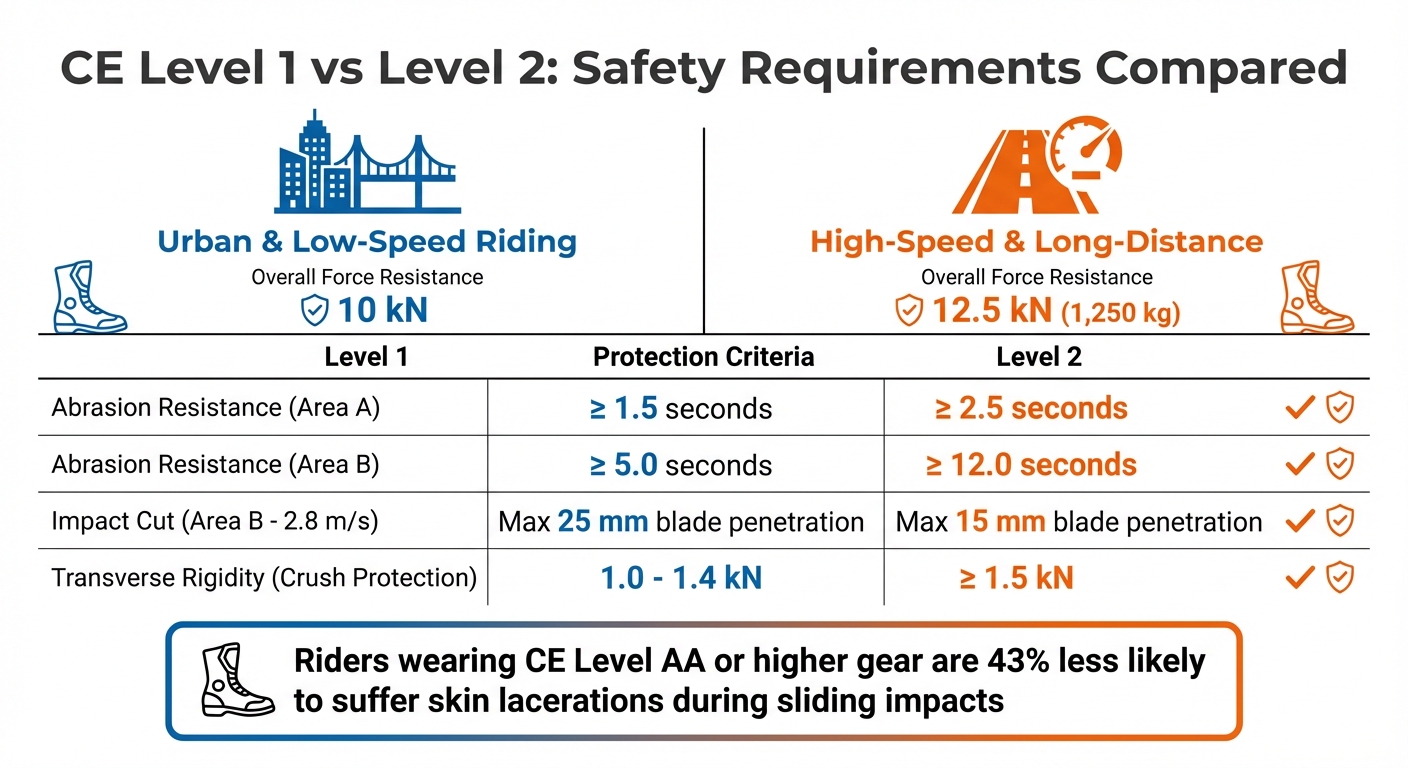
CE Level 1 vs Level 2 Motorcycle Boot Safety Requirements Comparison
Level 1 boots are designed for urban, low-speed riding, offering basic protection. On the other hand, Level 2 boots provide a higher degree of safety, making them suitable for high-speed and long-distance riding.
When it comes to abrasion testing for the main boot area (Area B), Level 2 boots need to endure at least 12 seconds of contact, compared to just 5 seconds for Level 1. In crush resistance tests, Level 2 boots must handle at least 1.5 kN, while Level 1 boots fall within a range of 1.0–1.4 kN. For impact cut resistance (Area B), Level 2 boots restrict blade penetration to 15 mm, whereas Level 1 boots allow up to 25 mm.
"Level 2 armour provides greater energy absorption, making it ideal for touring or performance riding." – ViaTerra Gear
Although Level 2 boots are bulkier and stiffer, requiring more time to break in, the added protection makes them a great choice for riders who frequently travel at higher speeds or embark on long trips.
Performance Requirements Compared
The table below highlights the technical differences between Level 1 and Level 2 boots:
| Test Category | Level 1 Requirement | Level 2 Requirement |
|---|---|---|
| Abrasion Resistance (Area A) | ≥ 1.5 seconds | ≥ 2.5 seconds |
| Abrasion Resistance (Area B) | ≥ 5.0 seconds | ≥ 12.0 seconds |
| Impact Cut (Area B - 2.8 m/s) | Max 25 mm protrusion | Max 15 mm protrusion |
| Transverse Rigidity (Crush) | 1.0 kN to 1.4 kN | ≥ 1.5 kN |
These standards ensure that each certification level aligns with the rider's specific safety needs. Level 1 boots are ideal for city riding, while Level 2 boots are better suited for highway and high-speed conditions.
How to Read the CE Label on Your Boots
The CE label is a permanent tag stitched inside your boot, usually located behind the tongue or along the inner side. It’s not a removable hangtag - if you only find it on a swing tag or a detachable liner, it doesn’t count as certification.
This label must include the code EN 13634:2017, which is the European standard for motorcycle protective footwear. You’ll often see a small motorcycle pictogram on the label, indicating that the boots are specifically designed for motorcycle safety.
One key feature of the label is the four-digit performance code (e.g., 2 2 2 1). Each number represents a specific test result:
- Boot height: Level 1 for ankle-high boots, Level 2 for shin-high boots.
- Abrasion resistance
- Impact cut resistance
- Transverse rigidity: Measures the boot’s ability to resist crushing forces.
Beyond these core safety ratings, you might also notice optional abbreviations that highlight additional features:
- WR: Water resistance
- IPA/IPS: Impact protection
- FO: Resistance to fuel and oil
Slip resistance is another important aspect, with codes like SRA, SRB, or SRC indicating the boot’s performance on various surfaces.
It’s crucial to ensure the label explicitly states EN 13634. Boots marketed as "CE approved" or "motorcycle style" without this specific standard haven’t been independently tested for motorcycle safety.
Understanding the CE label allows you to quickly confirm whether your boots meet the required safety standards.
Optional Slip Resistance Tests: SRA, SRB, SRC
In addition to the required CE tests, optional slip resistance ratings can provide extra assurance about a boot's grip on slippery surfaces. These ratings, part of the EN 13634 standard, assess how well a boot's sole performs in specific slippery conditions. While not mandatory, they offer a deeper look into a boot's traction capabilities.
The testing process involves using a mechanical heel set at a seven-degree angle to mimic typical walking and slipping scenarios. If a boot passes these tests, it earns one or more of the ratings - SRA, SRB, or SRC - which are displayed on the CE label beneath the mandatory performance scores. These ratings help clarify a boot’s performance on various surfaces.
It's worth mentioning that a rugged tread pattern doesn’t automatically mean a boot is slip-resistant. Only boots that undergo and pass these lab tests can carry the SRA, SRB, or SRC certification. While a boot can be fully CE-certified without these ratings, having them ensures verified performance on specific slippery surfaces.
SRA, SRB, and SRC Ratings Compared
Here’s a quick breakdown of what each rating represents:
| Rating | Test Surface | Lubricant | What It Indicates |
|---|---|---|---|
| SRA | Ceramic tile | Diluted soap (detergent) | Offers grip on wet, soapy tiles |
| SRB | Smooth steel | Glycerol (oil-like lubricant) | Provides traction on oily or greasy metal |
| SRC | Both tile and steel | Both soap and glycerol | Combines SRA and SRB for maximum slip resistance |
SRC isn’t a separate test but a combination of the SRA and SRB evaluations. If you often work in environments like oily garages or wet pavements, look for boots with an SRC rating. For situations involving mainly wet but non-oily surfaces, SRA-rated boots may suffice. On the other hand, SRB-rated boots are better for industrial settings where oil or chemical spills are common.
These slip resistance ratings enhance the mandatory safety standards, ensuring that your boots provide reliable protection across a variety of surfaces, much like the diverse terrain handled by road and off-road rider gear.
Why Choose CE-Rated Boots from Moto 1
Moto 1 offers a selection of CE-certified motorcycle boots tailored for New Zealand riders. Each boot in their range has undergone rigorous independent testing to meet the EN 13634:2017 standard. This ensures protection against abrasion, impact cuts, and crushing forces - key safety features for any rider. Similar protection is found in armour motorcycle jackets, which prioritize impact resistance for the upper body. The focus on independent testing underscores Moto 1's commitment to rider safety.
Moto 1's range stands out by offering boots across all three CE classes: Class A for urban commuting, Class AA for touring and daily rides, and Class AAA for high-performance track use. This variety allows you to choose boots that suit your riding style perfectly. Additionally, the range includes both Level 1 and Level 2 certifications, with clear labelling that outlines the level of protection provided.
Given New Zealand's unpredictable weather, many boots in the collection feature optional WR (Water Resistance) certification. This means they've passed a 1km water test, ensuring minimal internal dampness (≤3cm²). For added safety, some boots also come with SRC slip-resistance ratings, offering better grip on wet roads and slippery surfaces like steel floors and ceramic tiles - common hazards for Kiwi riders.
Each boot is marked with a permanent CE label, clearly confirming its safety certification. This transparency makes it easy to verify that you're investing in gear that meets your safety needs.
To make safety even more accessible, Moto 1 offers free shipping on qualifying orders, ensuring riders across New Zealand can access high-quality, certified protection.
Conclusion
CE certification ensures motorcycle boots meet the EN 13634:2017 standard, providing independent testing for abrasion resistance, impact cut protection, and transverse rigidity. These are the critical safeguards you need in the event of a crash or fall. Without this certification, you'd be trusting unverified marketing claims instead of proven safety standards.
Level 2 boots offer greater protection, withstanding 12.5 kN of impact force (equivalent to about 1,250 kilograms), compared to Level 1's 10 kN threshold. This makes them ideal for high-speed or demanding rides. In fact, research from the European Safety Institute revealed that riders wearing CE Level AA or higher gear were 43% less likely to suffer skin lacerations during sliding impacts.
"CE certification takes the guesswork out of safety." - Leather Collection Editorial Team
To ensure your boots offer genuine protection, look for the permanent internal label with the motorcycle icon and the EN 13634 code. This confirms the certification level, which you can match to your riding needs: Level 1 is suitable for urban commuting, while Level 2 is better for highway speeds or track use.
The best protection is the gear you’ll actually wear. Moto 1’s range of CE-certified boots offers tested safety and free shipping on qualifying orders across New Zealand, making it easier to prioritise your safety every time you ride.
FAQs
Do CE-rated boots always feel stiffer or harder to walk in?
CE-rated motorcycle boots aren't necessarily stiff or uncomfortable to walk in. The rigidity largely depends on the boot's design and the level of protection it offers. While boots with higher CE ratings, such as Level 2, might feel firmer due to their enhanced safety features, many models are crafted to strike a balance between protection and everyday comfort.
Can a boot be waterproof and still meet CE Level 2?
Yes, a boot can be both waterproof and meet CE Level 2 standards. The CE Level 2 rating focuses on safety elements like impact protection and abrasion resistance, which are entirely separate from waterproofing. Waterproofing is evaluated independently and doesn't interfere with the boot's ability to achieve CE Level 2 certification.
What should I do if my boots have a CE tag but no EN 13634:2017 code?
If your boots have a CE tag but don't include the EN 13634:2017 code, they might not comply with the specific European safety standard for motorcycle footwear. Always check the certification details to confirm they offer the protection you need, as not all CE tags ensure compliance with motorcycle safety standards.