

Motorcycle gloves are more than a comfort accessory - they’re essential for protecting your hands during a ride or fall. Here’s what you need to know:
- Safety Certifications: Look for gloves certified under EN 13594:2015. They meet strict standards for impact resistance, abrasion durability, and seam strength. CE Level 1 gloves suit city rides, while Level 2 gloves are better for high-speed or long-distance trips.
- Impact Protection: Features like knuckle guards and palm sliders reduce injury risks. Level 2 gloves offer greater protection, absorbing more force and lasting longer during abrasion tests.
- Materials: Leather (e.g., cowhide, goatskin, kangaroo leather) provides excellent abrasion resistance, while synthetic textiles like Kevlar balance durability with breathability.
- Fit and Comfort: A snug fit and secure retention systems are critical. Features like wrist closures, moisture-wicking liners, and ventilation panels improve both safety and Dainese motorcycle glove grip and comfort.
Whether you’re commuting or exploring New Zealand’s open roads, choosing the right gloves can make all the difference. Prioritise certified protection and a proper fit to ensure safety without compromising control.
Will Your Gloves Actually Protect You?
Choosing the right gear is essential for safety, so it helps to compare the best motorbike gloves in NZ that balance protection with rider comfort.
sbb-itb-bfda696
Certification Standards for Motorcycle Gloves
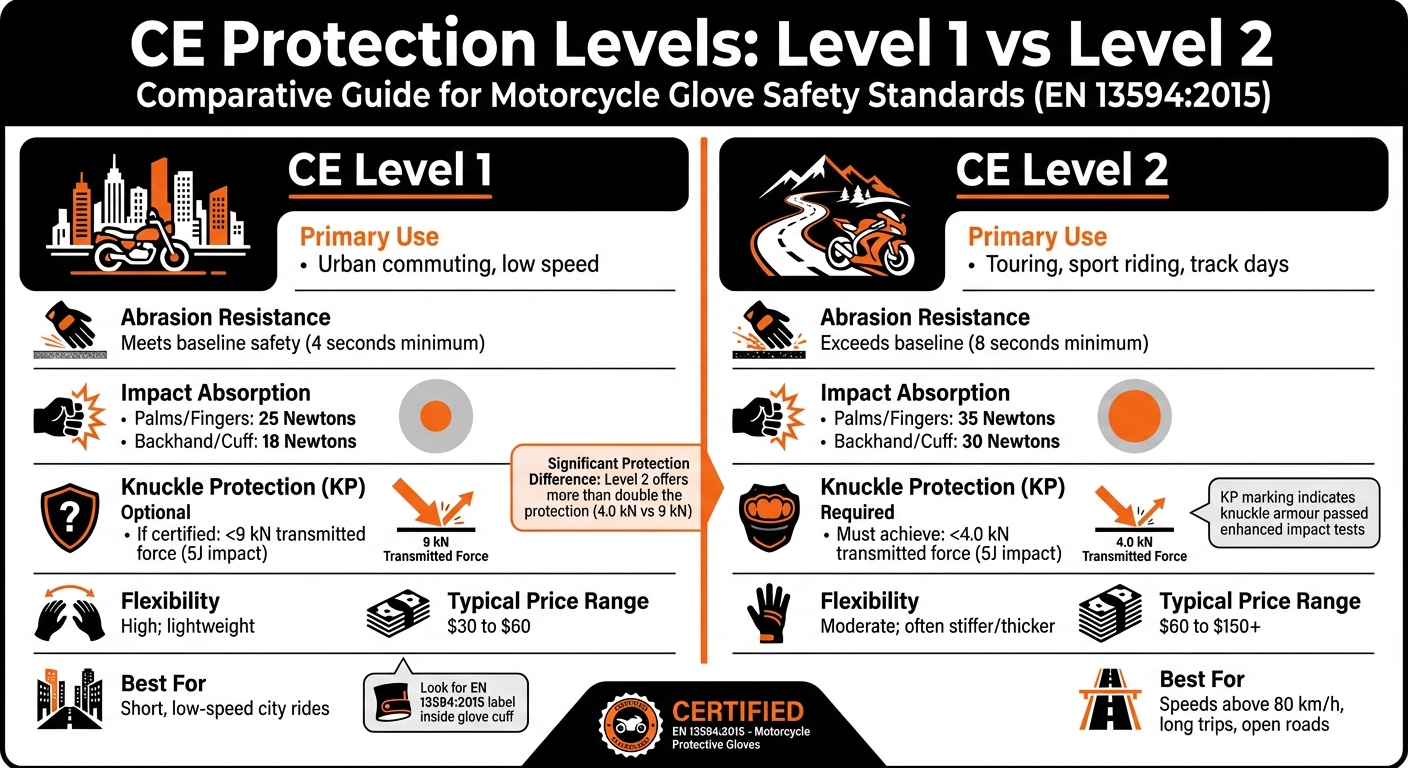
CE Level 1 vs Level 2 Motorcycle Glove Protection Standards Comparison
What CE Certification Means
CE stands for "Conformité Européenne" (European Conformity), and it's the main safety standard for motorcycle gloves in New Zealand. Since April 2018, all protective motorcycle gear has been classified as Personal Protective Equipment (PPE) and must be certified by an authorised body. For gloves, the specific standard is EN 13594:2015.
Gloves certified under EN 13594:2015 meet strict requirements for impact resistance, abrasion resistance, seam durability, tear strength, and material safety. For example, during abrasion tests, if a hole larger than 5mm appears in the fabric, the glove automatically fails.
"The application of the EN 17092 standard means that clothing that looks like protective motorcycle gear, actually is protective motorcycle gear!" - REV'IT!
When buying gloves, look for the EN 13594:2015 label inside the cuff. If it's not there, the gloves haven't been independently tested, and you're relying solely on marketing claims. Keep in mind, CE certification is valid for five years from the date of approval.
Understanding how these certifications translate into practical protection levels can help you pick the right gloves for your riding needs.
CE Protection Levels Explained
CE-certified gloves are divided into two protection levels, tailored for different types of riding. Level 1 gloves are designed for urban commuting and lower-speed rides, focusing on flexibility and lightweight construction while meeting basic safety requirements. Level 2 gloves, on the other hand, are built for high-speed riding, touring, or track use, offering enhanced abrasion resistance and impact protection.
The differences are significant. Level 2 gloves must handle 35 Newtons of force on the palms and fingers, and 30 Newtons on the backhand and cuff. For Level 1 gloves, the requirement is lower - 25 Newtons and 18 Newtons, respectively. Additionally, some gloves are marked with "KP" (Knuckle Protection), indicating that their knuckle armour has passed tougher impact tests.
| Feature | CE Level 1 | CE Level 2 |
|---|---|---|
| Primary Use | Urban commuting, low speed | Touring, sport riding, track days |
| Abrasion Resistance | Meets baseline safety | Exceeds baseline |
| Impact Absorption | Moderate | High-force dampening |
| Flexibility | High; lightweight | Moderate; often stiffer/thicker |
| Typical Price Range | $30 to $60 | $60 to $150+ |
These protection levels are designed to match different riding conditions. If you often ride at speeds above 80 km/h or take long trips on New Zealand's open roads, Level 2 gloves are the better option. For short, low-speed city rides, Level 1 gloves provide enough protection while offering greater flexibility. The key is to choose gloves that align with your riding habits rather than just going for the cheapest option.
Impact Protection Features
When it comes to motorcycle gloves, the way they handle impact is crucial. Riders often instinctively brace themselves with their hands during a fall, making proper hand protection a must, much like armour in motorcycle jackets.
Knuckle Guards
Knuckle guards play a key role in spreading out the force of an impact, easing the strain on your bones. Materials like viscoelastic foams (e.g., D3O) absorb and disperse shock, while hard-shell guards made from carbon fibre or titanium help your hand slide rather than snagging on the road. Under the EN 13594:2015 standard, knuckle protection is optional for Level 1 gloves but required for Level 2 gloves. To meet CE Level 1 standards, the knuckle armour must keep the transmitted force below 9 kiloNewtons (kN) when struck with 5 Joules of energy. For Level 2, this limit drops further to 4.0 kN, offering more than double the impact absorption. Gloves with this feature are marked with a 'KP' label. Some gloves also use floating knuckle systems, which ensure the armour stays in place even when gripping the throttle.
Palm Sliders
Palm sliders are designed to protect the heel of your palm and the base of your thumb during a fall. These hard inserts reduce the risk of wrist hyperextension and minimise friction, which helps to prevent heat buildup and road rash. Without these sliders, the glove material could snag on rough surfaces, potentially twisting your wrist in dangerous ways. By working in line with CE standards, palm sliders contribute to a more complete hand protection system.
Abrasion-Resistant Materials
The material of your gloves plays a huge role in how well they hold up during a slide. Leather is often the go-to choice because its natural fibrous structure wears down gradually instead of ripping apart all at once. This gives you those extra precious seconds of protection before the material wears through to your skin.
Cowhide is the most widely used option. At 1.0–1.4mm thick, it offers reliable durability without breaking the bank. If you’re after better flexibility and control, goatskin is a great alternative. It's softer and provides excellent tactile feedback, making it a popular choice for palm areas. At the premium end, kangaroo leather stands out. It has an impressive strength-to-weight ratio, offering the same protection as thicker cowhide but with less bulk. This makes it ideal for track or sport riders who need a strong connection to the handlebars.
Synthetic textiles like Cordura nylon and para-aramid fibres (such as Kevlar or Dyneema) are also great options. They combine high abrasion resistance with lighter weight and better breathability. Certification standards ensure these materials meet performance benchmarks: CE Level 1 requires at least 4 seconds of abrasion resistance, while Level 2 demands 8 seconds. Full-grain leather used for Level 2-rated gloves typically ranges from 1.2mm to 1.4mm in thickness.
Leather vs Synthetic Materials
When it comes to choosing between leather and synthetic materials, each has its strengths. Leather excels in slide protection and moulds to your hand over time, offering a customised fit. On the other hand, synthetic materials are lighter, more breathable, and often better at handling moisture. Many modern gloves combine the two, using leather in high-impact areas and textile mesh in less critical zones for improved ventilation. For track or sport riding, kangaroo leather is a top choice due to its unmatched feel. For touring or commuting, adventure gloves made from cowhide or durable textiles are more practical.
Regardless of the material, you’ll want gloves that reinforce key contact zones.
Reinforced High-Risk Areas
Even with the best materials, reinforcing high-risk areas is crucial. During a slide, the palm heels, fingertips, and thumbs take the brunt of the friction. That’s why these areas often feature double layers or palm sliders designed to minimise the chance of the glove catching on the pavement. High-end gloves go a step further, using 3–4 rows of high-tensile stitching to secure critical seams, ensuring they hold up under extreme conditions.
Kangaroo leather is often chosen for reinforced palm areas because it combines exceptional abrasion resistance with flexibility, even at thinner gauges. For added protection, look for gloves with raised sliders made of plastic, TPU, or ceramic on the palms. These not only reduce friction but also help prevent wrist injuries by minimising the risk of the glove "grabbing" the ground during a slide.
Fit, Retention, and Comfort Features
The most advanced protective materials won't mean much if your gloves don't stay on during a crash. That’s why ensuring a proper fit and having a solid retention system are not just about comfort - they're key safety factors.
Wrist Retention Systems
A good wrist closure system is designed to keep your gloves securely in place, even when facing the friction of a slide on pavement. The most reliable designs feature a dual-closure system: a wide hook-and-loop strap paired with a narrower strap that locks the glove firmly. Some models even include TPU stabilisers to help prevent wrist hyperextension.
When shopping for gloves, test the retention system by fastening the straps and pulling the glove by the fingers. If it slips off easily, the system may not be effective, or you might need a smaller size. For gauntlet-style gloves, ensure they overlap your jacket sleeves by at least 5cm. This overlap protects your skin from exposure and keeps out wind, rain, and debris.
Ventilation and Moisture Control
Gloves that stay secure also need to handle moisture and airflow well. New Zealand's weather can vary widely - from the humid summers of the North Island to the wet, coastal conditions elsewhere - so proper ventilation and moisture management are essential for both comfort and safety. Perforated panels allow cooling airflow, which is especially helpful in summer. For rain-prone areas, gloves with GORE-TEX or Hydratex membranes are ideal. These materials block external water while letting sweat escape, preventing that clammy, uncomfortable feeling.
Moisture-wicking liners are another important feature. They draw sweat away from your skin, keeping your hands dry and comfortable even in fluctuating temperatures. This isn’t just about comfort - cold or sweaty hands can slow your reaction time, which makes ventilation a safety concern too. Leather gloves typically stretch 5–10% during an 8–12-hour break-in period, moulding to your hand for a custom fit. In contrast, textile gloves hold their shape with minimal stretching.
Grip and Hand Movement
Comfort and ventilation aside, maintaining natural hand movement is critical for control. Accordion panels built into gloves allow your hands to move naturally, reducing fatigue during long rides. Materials like goatskin and two-way stretch fabrics, combined with silicone grips on the palms and fingers, ensure flexibility and control. This is particularly useful for precise throttle and brake operation, especially in wet conditions.
A proper fit is essential for maintaining control. Gloves that restrict your hand when making a fist or cut off circulation are too small. On the other hand, excess material at the fingertips can make it harder to operate the clutch and brake levers effectively.
How to Choose the Right Motorcycle Gloves
Finding the Right Balance Between Safety and Comfort
When choosing motorcycle gloves, start by checking the EN 13594:2015 certification tag. This standard ensures the gloves meet Level 1 protection for urban rides or Level 2 for high-speed touring. Keep in mind, gloves can have varying protection levels in different areas. For example, a glove might offer Level 2 impact protection but only Level 1 abrasion resistance.
A proper fit is critical for both safety and comfort. The gloves should fit snugly, with no more than 6 mm of extra room at the fingertips. Make a fist to see if the glove moves naturally with your hand, and ensure the wrist strap secures it firmly. To test this, secure the strap and try pulling the glove off by the fingertips - it should stay in place. As Odin Mfg wisely notes, "If the glove shifts independently from your hand, it will fail when you need it". These fit checks are just as important as the advanced protection features.
Speaking of protection, prioritise gloves with strong impact and abrasion resistance. Look for reinforced knuckles, palms, and fingers. Materials like full-grain leather (1.2–1.4 mm thick) are excellent for moulding to your hand while offering reliable abrasion resistance. Advanced textiles like Kevlar add waterproofing but may sacrifice some abrasion durability. Don’t overlook palm sliders - they’re essential for reducing the risk of wrist fractures by allowing your hand to slide instead of catching on the pavement.
Browse Certified Gloves on Moto 1
Moto 1 offers a wide selection of certified motorcycle gloves that meet the EN 13594:2015 standard. Whether you need short-cuff gloves for city commutes or gauntlet-style gloves for all-weather touring, there’s something for every rider. Plus, orders over a certain amount qualify for free shipping, so you can get the right gear delivered straight to your door hassle-free.
FAQs
How can I tell if gloves are genuinely EN 13594:2015 certified?
To verify EN 13594:2015 certification, look for the CE mark and the certification level - either Level 1 or Level 2 - inside the glove cuff. This certification ensures the gloves meet critical performance standards such as abrasion resistance, impact protection, and cut resistance, all of which are confirmed through rigorous testing. Be sure to check the label or any accompanying documentation for these details.
Do I need CE Level 2 gloves for New Zealand open-road riding?
Yes, CE Level 2 gloves are a great choice for open-road riding in New Zealand. They offer higher levels of impact and abrasion resistance, which is crucial for handling high speeds and frequent touring conditions. Opting for gloves with this certification ensures stronger protection and durability - perfect for long rides across New Zealand's varied road conditions.
What glove fit checks matter most for crash safety?
Proper crash safety gear needs to fit just right to do its job. Start by checking that impact protectors are firmly in place and won't shift around. Also, make sure wrist fasteners on gloves are secured on the inside. This positioning helps prevent gloves from slipping off or tearing if an accident occurs. Getting the fit right is essential for reducing injury risks and ensuring maximum protection.