

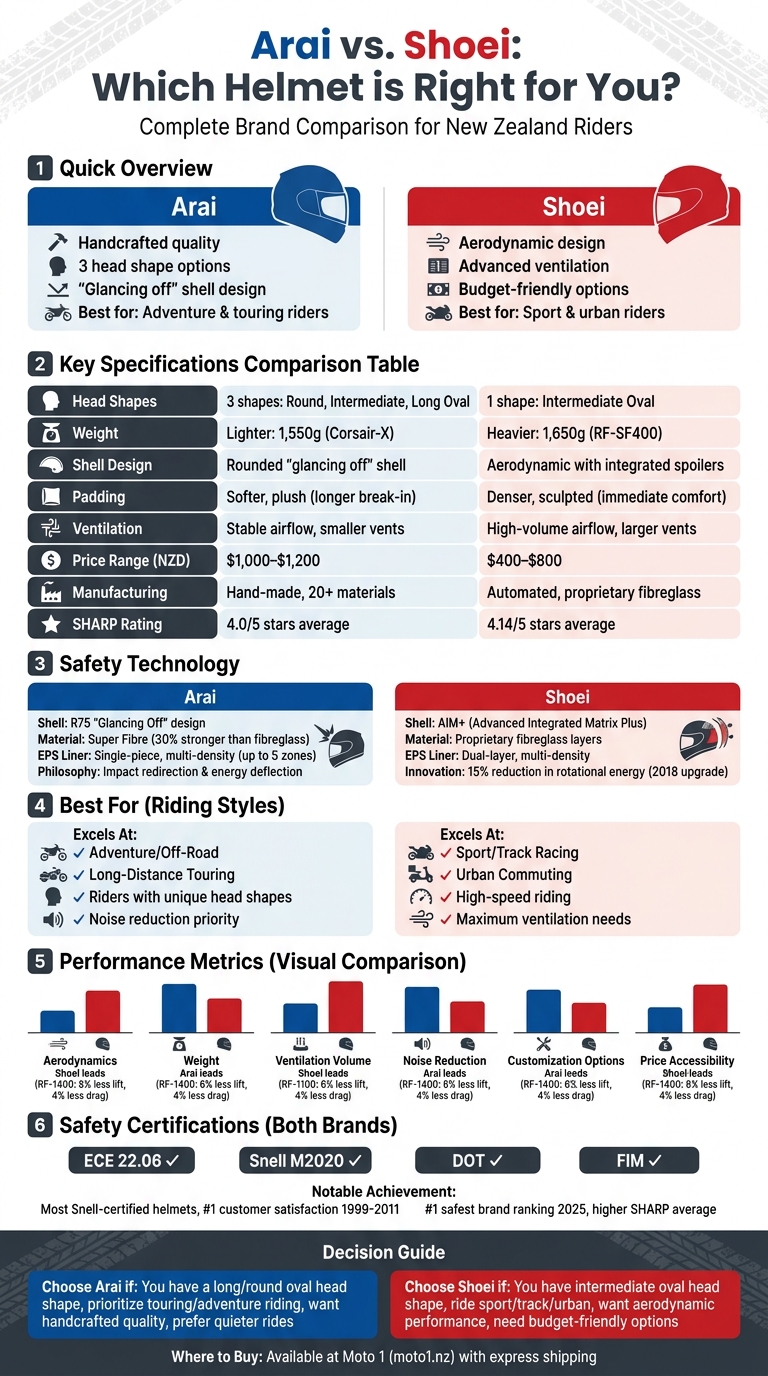
When choosing between Arai and Shoei helmets, it comes down to your priorities: fit, safety, ventilation, and riding style. Both brands are trusted globally and meet or exceed safety standards like ECE 22.06 and Snell M2020. Arai focuses on handcrafted quality, customisable fit for various head shapes, and a "glancing off" shell design for impact deflection. Shoei, on the other hand, offers aerodynamic designs, advanced ventilation, and a more budget-friendly price range.
Key Points:
- Arai: Best for riders with unique head shapes (Round Oval, Long Oval), adventure riding, and those prioritising hand-crafted helmets with excellent noise reduction.
- Shoei: Ideal for most riders (Intermediate Oval head shape), urban commuters, sport/track enthusiasts, and those seeking aerodynamic features and high-volume airflow.
Quick Comparison Table:
| Feature | Arai | Shoei |
|---|---|---|
| Head Shape Options | 3 shapes: Round, Intermediate, Long Oval | 1 shape: Intermediate Oval |
| Shell Design | "Glancing off" rounded shell | Aerodynamic, integrated spoilers |
| Weight | Lighter (e.g., Corsair-X: 1,550g) | Slightly heavier (e.g., RF-SF400: 1,650g) |
| Padding | Softer, plush | Denser, immediate comfort |
| Ventilation | Stable airflow, smaller vents | High airflow, larger vents |
| Price Range (NZD) | $1,000–$1,200 | $400–$800 |
For riders in New Zealand, Arai suits long-distance touring and off-road adventures, while Shoei excels in urban and high-speed conditions. Both brands are available at Moto 1 with express shipping options.
Arai vs Shoei Motorcycle Helmets Complete Comparison Guide
Safety Features
Shell Design and Impact Protection
Arai and Shoei take different approaches to crash protection. Arai's R75 design focuses on deflecting impact energy by allowing the helmet to "glance off" forces during a collision.
"Arai believes that the ability to glance off energy is one of the most important performance characteristics of a helmet." – Arai Americas
Shoei, on the other hand, uses AIM+ (Advanced Integrated Matrix Plus) shell technology. This design not only absorbs and disperses impact energy but also improves rider comfort with aerodynamic shaping.
Arai's shells are crafted by hand with over 20 materials, including their proprietary "Super Fibre" composite, which is 30% stronger than standard fibreglass. Each shell, approximately 3 mm thick, undergoes two inspections by specialists. Shoei employs advanced automated techniques to layer proprietary fibreglass, producing helmets that maintain high safety standards while often being more cost-effective.
EPS Liner Technology
The EPS (Expanded Polystyrene) liner plays a critical role in absorbing crash impact energy. Arai uses a single-piece, multi-density liner with up to five zones of varying density. This design ensures softer areas handle low-speed impacts, while firmer zones manage higher forces. Shoei's dual-layer, multi-density EPS system features a softer top layer for quick energy absorption and a firmer lower layer for additional support. In 2018, Shoei introduced an upgraded liner designed to reduce rotational energy by 15%. Both systems align with the safety standards the brands strive to meet.
Safety Certifications
Both Arai and Shoei helmets meet or exceed major global safety certifications, including ECE 22.06, Snell M2020, DOT, and FIM. The ECE 22.06 standard is especially demanding, testing 12 random impact points and incorporating angled tests to measure rotational forces. Arai's Quantic was the first helmet to meet this updated standard, followed by models like the ECE 22.06 approved Concept-XE.
"Standards are important and set minimum criteria, but while some may design their helmets to meet those minimums, 'good enough' has never been good enough around here." – Arai Americas
Arai holds the record for the most Snell-certified helmets and was ranked first in customer satisfaction for 13 straight years (1999–2011) in the J.D. Power and Associates Motorcycle Helmet Satisfaction Study. Meanwhile, UK SHARP testing shows that Shoei helmets generally achieve slightly higher average star ratings. Models like the X-Fourteen and RF-SR have earned perfect 5-star ratings, while Arai's Signet-X and Corsair-X have also achieved top marks. In the 2025 safest brand rankings, Shoei claimed the #1 spot, with Arai ranked at #3.
Safety Features Comparison Table
| Safety Feature | Arai | Shoei |
|---|---|---|
| Shell Technology | R75 "Glancing Off" (rounded, smooth) | AIM+ (aerodynamic, multi-axis) |
| Shell Material | Super Fibre (30% stronger than fibreglass) | Proprietary fibreglass layers |
| EPS Liner Type | Single-piece, multi-density (up to 5 zones) | Dual-layer, multi-density |
| Safety Philosophy | Impact redirection and energy deflection | Energy absorption and aerodynamic stability |
| Primary Certifications | ECE 22.06, Snell M2020, DOT, FIM | ECE 22.06, Snell M2020, DOT, FIM |
| Manufacturing | Hand-made; over 20 materials per shell | Contemporary automated methods |
| SHARP Average Rating | 4.0/5 stars | 4.14/5 stars |
sbb-itb-bfda696
Fit and Comfort
Head Shape Options
Arai and Shoei have different philosophies when it comes to fitting various head shapes. Arai offers three distinct internal profiles: Round Oval, Intermediate Oval, and Long Oval. This range caters to a broader spectrum of head shapes, from rounder profiles to longer, narrower ones.
"Arai helmets typically accommodate rounder head shapes with a more circular internal profile... Shoei helmets generally suit riders with oval-shaped heads, offering a longer front-to-back internal dimension." – Moto Deals
Shoei, on the other hand, focuses on the Intermediate Oval shape, which fits about 75–85% of riders. While this approach works well for most, riders with long oval or round oval head shapes might experience discomfort, particularly around the forehead.
If your head shape leans towards the long oval category, starting with Arai is a smart choice. For those whose head shape aligns with the intermediate oval profile, Shoei helmets are likely to feel comfortable right out of the box.
Customisable Liners and Cheek Pads
Adjustability is crucial for a snug fit and overall comfort. Arai's Micro-Fit System allows for fine-tuning with 5mm peel-away layers in the temple and cheek pads. Shoei takes a different approach, offering interchangeable internal components. Some Arai helmets even let you swap liners between models, such as converting a Round Oval Quantum-X into an Intermediate Oval using liners from the Signet-X or Corsair-X.
"The simple truth is that a better-fitting helmet is not only more comfortable, but protects better." – Arai
Arai’s padding tends to be softer and more plush, which may require some time to break in. Shoei’s padding, on the other hand, is denser and sculpted for immediate comfort. Shoei also incorporates a 3D Max-Dry liner, which excels at moisture-wicking and contributes to quieter rides.
Beyond padding and liners, the overall weight of a helmet also plays a big role in comfort, especially on long rides.
Weight and Long-Ride Comfort
The weight of a helmet can significantly impact comfort during extended rides. Lighter helmets help reduce neck strain and fatigue. Arai helmets tend to be lighter than Shoei models. For instance, the Arai Corsair-X weighs roughly 1,550g, compared to the Shoei RF-SF400, which weighs about 1,650g.
"Shoei's philosophy asserts that a lighter helmet alleviates strain on the neck muscles, ensuring a more comfortable riding experience and, by extension, reducing the likelihood of an accident." – Motohut
However, weight isn’t the only factor. Shoei’s aerodynamic designs, with integrated spoilers, help reduce lift and turbulence, making the helmet feel lighter at higher speeds.
Arai’s smooth shell design and soft-sealing chin curtain help reduce wind noise, which many riders appreciate on long trips. The softer padding is also a favourite among those who wear glasses or are sensitive to pressure points. To ensure a helmet fits well, wear it for at least 20 minutes to identify any potential discomfort.
Fit and Comfort Comparison Table
| Feature | Arai | Shoei |
|---|---|---|
| Head Shape Options | 3 distinct shapes (Round, Intermediate, Long Oval) | Primarily 1 shape (Intermediate Oval) |
| Internal Profile | More circular; shorter peak-to-peak | Elongated front-to-back |
| Padding Feel | Softer, plush | Denser, sculpted |
| Micro-Adjustment | 5mm peel-away temple and cheek layers | Interchangeable internal components |
| Break-in Period | Longer | Short; immediate comfort |
| Average Weight | Lighter (e.g., Corsair-X: 1,550g) | Heavier (e.g., RF-SF400: 1,650g) |
| Customisation | Extensive dealer network options | Removable/replaceable pads |
| Noise Control | Excellent (smooth shell reduces wind roar) | Very good (aerodynamic stability) |
Ventilation and Aerodynamics
Ventilation Systems
Arai and Shoei take distinctly different approaches to helmet ventilation. Shoei emphasises high-volume airflow by incorporating larger intake and exhaust ports, which are highly effective for managing heat. This makes Shoei helmets a great option for riders who frequently deal with stop-and-go traffic or ride in humid conditions.
"Shoei's ventilation systems typically move more air volume through the helmet, featuring larger intake and exhaust ports." – Moto Deals
Arai, on the other hand, focuses on creating a turbulence-free airflow with smaller, carefully placed vents. This design shines in scenarios where temperature changes are common, such as riding through New Zealand's diverse landscapes, from coastal roads to alpine regions. Additionally, while Shoei includes Pinlock anti-fog inserts with most helmets, Arai often requires riders to purchase these separately.
For riders navigating New Zealand's unpredictable weather and frequent elevation changes, Arai's ability to maintain stable internal temperatures and reduce fogging can be a game-changer. However, if your rides often take you through warmer areas or heavy traffic, Shoei's superior cooling and airflow make it the better choice. Ventilation keeps the rider comfortable, but aerodynamic design plays a key role in ensuring stability at speed.
Aerodynamic Stability
Shoei complements its ventilation strategy with aerodynamic designs that feature elongated shell shapes and integrated spoilers. These elements help reduce wind buffeting and lift, making Shoei helmets particularly suitable for sport and track riders who demand consistent performance at high speeds. The sharp angles and compound curves enhance stability, especially on highways and race tracks.
Arai takes a different route, focusing on their "R75" shell design. This rounded, smooth shape prioritises safety by allowing the helmet to "glance off" surfaces during impacts. While this design reduces wind noise and roar – a benefit that lowers rider fatigue on long trips – it doesn't include the aggressive aerodynamic features found in Shoei helmets. Arai also designs external components to detach upon impact, avoiding fixed spoilers that might compromise safety.
"Arai's smooth shell and soft-sealing chin curtain reduce wind roar. Many users report lower fatigue on long trips." – Andre Silva
Performance by Riding Style
Adventure and Motocross
Arai helmets are built around a "glancing off" principle, which redirects impact energy from unexpected angles - a critical feature when tackling New Zealand's varied off-road trails. Their smooth, rounded shells are meticulously hand-crafted using multiple fibreglass layers and over 20 distinct materials. This approach ensures outstanding durability and efficient energy distribution during impacts. Plus, Arai helmets are lightweight, which helps to minimise neck fatigue during long, technical rides.
This focus on impact redirection is especially useful in challenging terrains where obstacles may strike from unpredictable directions. Shifting gears from rugged trails to high-speed roads, let's explore how these helmets perform in touring and racing scenarios.
Touring and Racing
Shoei helmets, known for their safety and comfort, also shine in aerodynamic performance - an essential feature for both touring and racing. For instance, the RF-1400 model cuts lift by 6% and drag by 4% compared to its predecessor, the RF-1200. These improvements reduce neck strain and enhance stability, especially on New Zealand's open roads. Sport and track riders often choose Shoei for its wind-tunnel-tested designs, which include integrated spoilers to minimise buffeting. A standout model, the X-Fourteen, features six intake and six exhaust ports, ensuring maximum cooling during intense rides.
Touring riders, on the other hand, benefit from Shoei's modular options. The Neotec 3, priced around $900, offers flip-up convenience for quick stops, along with lighter weight and superior ventilation to combat fatigue on long journeys.
Riding Style Performance Comparison Table
| Riding Style | Recommended Brand | Key Advantage |
|---|---|---|
| Adventure/Off-Road | Arai | "Glancing off" shell design that redirects impact energy |
| Sport/Track | Shoei | Aerodynamic efficiency with integrated spoilers |
| Long-Distance Touring | Shoei | Modular design and aerodynamic efficiency reduce fatigue |
| Commuting/Urban | Shoei | High-volume ventilation with Pinlock inserts |
| Racing | Shoei | Wind-tunnel-tested design that reduces lift and drag |
Conclusion
Key Takeaways
Here’s a quick rundown of the main points that set Arai and Shoei helmets apart.
Both brands meet DOT, ECE, and SNELL certifications, ensuring they’re safe and legal for use on New Zealand roads. Choosing between them ultimately comes down to your head shape, riding style, and personal preferences.
Arai stands out for its handcrafted design and "glancing off" shell concept, which helps deflect impact energy with its rounder, smoother shape. If you have a long oval head shape or prioritise simplicity and noise reduction, Arai’s three shell shapes and customisation options are worth considering. These helmets are especially well-suited for adventure and touring riders, thanks to their lightweight build and ultra-comfortable liners that help minimise fatigue during long trips.
Shoei, on the other hand, focuses on active safety and cutting-edge features. With an intermediate oval shape that fits most riders (75–85%), Shoei helmets cater to sport, track, and urban riders. Extras like built-in sun visors and compatibility with communication systems add to their appeal. Shoei helmets are priced between $400–$800, and replacement parts such as face shields are relatively affordable and easy to find.
"Arai gains an edge for potential collision scenarios, while Shoei's emphasis on comfort makes it an appealing choice for extended rides."
- Sorrell Sohota
If you’re ready to make a choice, check out the options below.
Shop Arai and Shoei Helmets on Moto 1

New Zealand riders can explore both brands at Moto 1, which offers express shipping and free delivery on orders over $95. Whether you’re looking at the Arai Quantic for $1,099 or the Shoei GT-Air 3 for $1,049, Moto 1 has a range of helmets tailored to road, adventure, and track riding. All helmets meet ECE 22.05 or ECE 22.06 safety standards. To complete your setup, the store also stocks accessories like SENA Bluetooth systems and Pinlock anti-fog inserts.
Arai vs. Shoei: Which Race Helmet Is Safer, Quieter & More Comfortable?
FAQs
How do I figure out my head shape for helmet fit?
To figure out your head shape, measure around the widest part of your head - just above your eyebrows and ears. This will help you determine whether your head shape is long-oval, intermediate oval, or round. For example, Arai helmets are often a good match for long-oval head shapes, while Shoei helmets tend to work better for intermediate ovals. However, the most reliable way to find the right fit is by trying helmets on and checking how comfortable they feel around your face and ears.
Is ECE 22.06 enough, or should I also look for Snell?
ECE 22.06 is a respected European safety standard that ensures helmets meet strict impact and penetration criteria, making them legally approved for road use in New Zealand. This standard guarantees a solid level of protection for everyday riders.
On the other hand, Snell certification takes testing a step further. It includes more intensive evaluations, such as impact resistance and shell penetration tests under simulated crash conditions. This makes Snell-certified helmets a popular choice for riders seeking extra reassurance, particularly in competitive or high-risk scenarios.
For those looking for maximum safety, a helmet that meets both ECE 22.06 and Snell certifications offers an added layer of trust in its protective capabilities.
What should I prioritise for NZ riding: ventilation or noise?
Your choice should match your riding style and the conditions you face. Shoei helmets are known for their excellent ventilation, making them a great option for hot weather or high-speed rides where airflow is essential. On the other hand, Arai helmets focus on keeping things quiet, featuring smooth shells and plush liners that help minimise noise - ideal for long-distance trips.
For riders in New Zealand, it comes down to what you value more: cooling airflow during warmer rides or a quieter experience for those extended journeys. Pick what suits your needs best.