

Your helmet's fit is the key to safety and comfort on New Zealand roads. A poorly fitted helmet can compromise protection during an accident or cause discomfort while riding. Here's how to get it right:
- Measure your head circumference: Use a soft tape measure around the widest part of your head (2.5 cm above your eyebrows and ears). Double-check for accuracy.
- Identify your head shape: Long Oval, Intermediate Oval, or Round Oval. This ensures the helmet matches your contours.
- Match measurements to size charts: Always refer to the specific LS2 brand's chart - sizes vary across manufacturers.
- Test the fit: A snug helmet should sit level, with no gaps or excessive movement. Cheek pads should feel firm but not painful.
- Check safety standards: Look for certifications like ECE 22.06, AS/NZS 1698, or DOT to ensure your helmet is legal and reliable.
Helmets should be replaced every five years, as materials degrade over time. A good fit not only ensures safety but also enhances your riding experience. Keep reading to learn the full process, from measuring to testing fit.
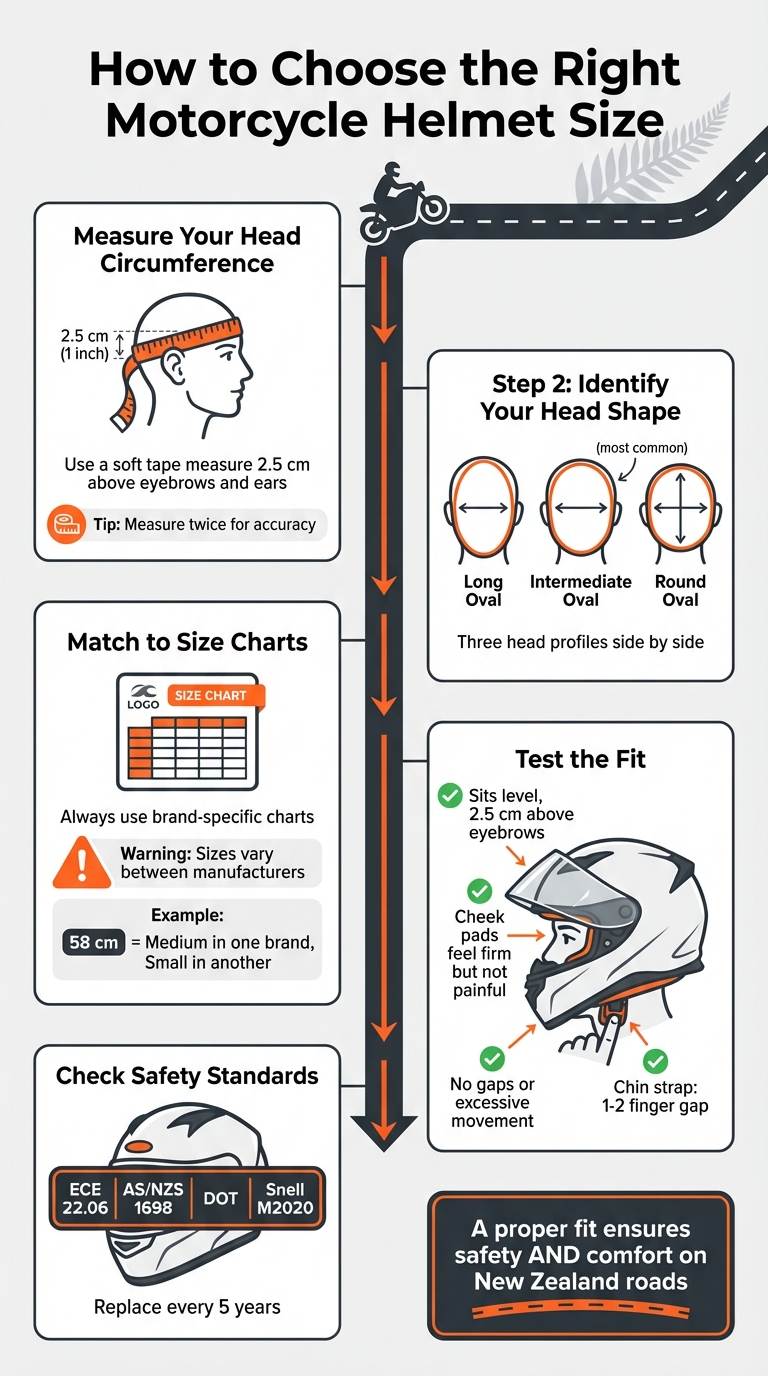
5-Step Guide to Choosing the Right Motorcycle Helmet Size
Motorcycle Helmet Fitting Guide: Find Your Perfect Size | FortaMoto.com

Measure Your Head Circumference
Getting the right helmet starts with knowing your head size. In New Zealand, helmet sizes are measured in centimetres (cm). To ensure accuracy, you'll need a soft, flexible tape measure - like the ones used for sewing. If you don’t have one, grab a piece of string, wrap it around your head, and then measure the string with a ruler.
Step-by-Step Measuring Instructions
Place the tape about 2.5 cm above your eyebrows and just above your ears. This ensures you're measuring the widest part of your head, which is key for a proper fit. Keep the tape level all the way around - from the front of your forehead to the most prominent part at the back of your head. The tape should feel snug against your skin - firm, but how tight should a motorcycle helmet be is a common question for new riders. If you have thick or curly hair, flatten it down to avoid an inaccurate reading. Take the measurement at least twice to make sure you record the largest number.
Tips for Accurate Measurements
Having someone assist you can make this process much easier, as they can help keep the tape level while you check the measurement. If you’re doing it solo, use a mirror to ensure the tape stays in the correct position. Avoid stiff, metal tape measures; they can’t follow the natural shape of your head. Also, remove any hats, hair clips, or accessories that might interfere with the measurement. The tape should naturally contour to your head - neither stretched too tight nor left loose. Once you have your measurement, consider your head shape to narrow down your helmet choices further. After finding the right size, it is equally important to know how to put on a motorcycle helmet correctly to ensure the safety features function as intended.
Identify Your Head Shape
Once you’ve measured your head size, the next step is figuring out your head shape. This is just as important because helmet fit isn’t only about circumference - it’s also about the shape of your head. Helmets are typically designed to fit three main head profiles: long oval, intermediate oval, and round oval.
- Long oval: This shape has a noticeably longer front-to-back measurement compared to its width.
- Intermediate oval: Slightly longer front-to-back than side-to-side, this is the most common shape, and many helmets are made with this profile in mind.
- Round oval: Nearly equal measurements front-to-back and side-to-side, often likened to the shape of a football.
"Two riders with the same basic measurements may have entirely different head shapes." - moto1.nz
Even if two riders have the same head circumference, their head shapes can vary. This means a helmet that fits one person perfectly might feel uncomfortable - or even unsafe - for someone else. A poor shape match can cause "hot spots" (pressure points) or leave gaps between your head and the helmet liner (or require replacement HJC helmet liners to adjust the fit), which could reduce its effectiveness during an impact.
How to Determine Your Head Shape
The easiest way to identify your head shape is to take a top-down photo of your head (flatten your hair first) or look at your profile in a mirror. Compare the front-to-back length with the side-to-side width. If you want to be more precise, use a measuring tool. A noticeable difference between the two measurements suggests a long oval shape, while nearly equal dimensions indicate a round oval. Understanding your head shape helps you pick a helmet that hugs your contours just right .
Why Head Shape Affects Fit
Matching your head shape to a helmet’s design is crucial for both safety and comfort. Helmets are built with specific profiles in mind, so an improper match can lead to discomfort or even reduced protection. For instance, a long oval rider wearing a round helmet might feel pressure on the forehead, while the sides feel loose. Similarly, a round oval rider in a long oval helmet could experience gaps that compromise the helmet’s fit.
Since intermediate oval is the most common head shape, riders with this profile often have more options to choose from. But for any shape, finding the right match ensures the helmet fits snugly and performs as intended when it matters most.
Match Your Measurements to Helmet Size Charts
Once you've figured out your head circumference and shape, the next step is matching these measurements to the correct size using the specific helmet model's chart. Keep in mind that helmet sizing isn’t standardised - a "Medium" in one brand might translate to a "Small" or "Large" in another. This is why it’s crucial to rely on the manufacturer’s chart rather than assuming sizes based on previous purchases.
"One brand might label 58 cm as a Medium size, while another may list it as a Small. Always match your exact head measurement to the brand's chart rather than assuming you know your size." - Kiwi Sizing
Instead of relying on general size labels like S, M, or L, use your precise head circumference in centimetres. For instance, if your measurement is 57 cm, look for that exact number in the size chart provided by the manufacturer. Always double-check your measurement against the specific chart for the helmet model you're considering, as sizing can differ even within the same brand.
Using Brand-Specific Size Charts
Every helmet brand provides its own size chart, which typically includes head circumference ranges in centimetres alongside the corresponding helmet sizes. For example, one brand might classify 57/58 cm as a Medium, while another might group 56–59 cm under an M/L size. These variations occur because manufacturers design their helmets with different shell shapes and internal headforms.
To find the right fit, locate the specific model's size chart on the product page or packaging and match your head circumference to the listed range. While these charts focus on circumference, your head shape also plays a big role. A helmet might seem like the correct size on paper but feel uncomfortable if its shape doesn’t align with your head profile. If you’re unsure about a particular brand, check customer reviews or product descriptions for "fit notes" that can indicate whether the helmet tends to run small or large. If your measurement is on the border between two sizes, don’t worry - there’s a way to handle that.
What to Do If Between Sizes
If your head measurement falls between two sizes, it’s generally better to go with the smaller option. Motorcycle helmets are designed with internal foam and padding that moulds to your head over time, becoming more comfortable after the first few rides. A helmet that feels snug initially might loosen slightly as the padding compresses.
If you’re still uncertain, visiting a store to try on helmets is a smart move. This allows you to check for any pressure points, particularly on your forehead or temples, and ensure the helmet doesn’t rotate or shift when you move your head. A helmet that’s too large can shift during an impact, reducing its effectiveness, while one that’s too tight can cause discomfort and even headaches.
sbb-itb-bfda696
Check Helmet Fit and Comfort
After matching your measurements to a size chart, the next step is to physically try on the helmet to ensure it fits correctly. A helmet might seem perfect on paper, but the real test is how it feels on your head. This step is essential because a helmet that's too tight or too loose can affect both your safety and comfort while riding.
Proper Fit Checklist
A well-fitted helmet should feel snug around your entire head without causing pain or discomfort. It should sit level, about 2.5 cm above your eyebrows, ensuring your vision remains centred. There shouldn’t be any noticeable gap between the inner liner and the top of your head - such gaps suggest the helmet’s shape doesn’t match your head profile.
Pay close attention to the cheek pads. These should press firmly against your face, and while they might feel tight initially, this is normal. As Michelin explains, "There is only one area where you should feel tight and that is in the cheeks. At first this may seem uncomfortable, but the foams will settle over time."
Fasten the chin strap and test for movement. Roll the helmet forward and backward - if it shifts significantly or exposes your forehead, it’s too loose. Experts advise that if you can roll the helmet forward to block your vision or backward to expose your forehead, it doesn’t fit properly. When the chin strap is secured, there should only be enough room to fit one or two fingers between the strap and your chin.
If any of these issues arise, adjustments or changes may be needed. Keep reading for tips on resolving common fit problems.
Fixing Common Fitting Problems
Pressure points or excessive movement are signs that the helmet isn’t the right size or shape. If you notice red marks or discomfort on your forehead after a few minutes of wear, the helmet might be too small or incompatible with your head shape. To spot less obvious pressure points, wear the helmet indoors for at least 20 minutes.
If the cheek pads are the only issue, consider swapping them out for a different size. A loose helmet can shift during a ride, block your vision, or even come off in an accident. On the other hand, a helmet that’s too tight can cause headaches and make riding uncomfortable. Finding the right balance is key to both safety and comfort. Once you've found the perfect fit, proper helmet care and maintenance will ensure it stays in top condition for years to come.
Understand Helmet Safety Standards
Ensuring your helmet fits well and meets safety standards is crucial for staying protected on New Zealand roads. It's not just about comfort - it's also the law. In New Zealand, every motorcycle rider and pillion passenger must wear an approved safety helmet that's securely fastened. Riding with a non-certified helmet isn't only illegal; it could also void your insurance if you're involved in an accident.
Key Safety Certifications
In New Zealand, helmets must meet recognised international or local safety standards. Here are the most common certifications you'll encounter:
- ECE 22.05 or ECE 22.06: These European standards are widely respected and even used in professional racing.
- AS/NZS 1698: The joint Australian and New Zealand standard.
- DOT FMVSS 218: The United States Department of Transport standard.
- Snell M2020: A high-performance standard often associated with premium helmets.
| Certification Standard | Origin | Status in New Zealand |
|---|---|---|
| ECE 22.05 / 22.06 | Europe | Legally recognised and widely used |
| AS/NZS 1698 | Australia/NZ | Legally recognised local standard |
| DOT FMVSS 218 | USA | Legally recognised |
| Snell M2020 | USA (Private) | Recognised high-performance standard |
| BSI | UK | Internationally accepted |
ECE-certified helmets also include specific labels indicating their features: 'J' for helmets without a chin-piece, 'P' for those with a tested protective chin-piece, and 'NP' for helmets with a non-protective chin-piece. Helmets without proper certification do not meet New Zealand's road safety requirements and should be avoided.
Why Certification Matters
Certified helmets undergo rigorous testing to ensure they can absorb impact, resist penetration, and stay securely in place during a crash. Always check for a certification sticker or label, typically found on the back or inside of the helmet, before making a purchase.
"If your helmet isn't certified for use in New Zealand, your insurance may not cover you after a motorcycle accident."
Steer clear of second-hand helmets, as internal damage - especially to the EPS foam - might not be visible. Additionally, helmets should be replaced every five years, as the inner liner naturally degrades over time.
Conclusion
Picking the right motorcycle helmet size involves a few key steps to ensure both safety and comfort. Start by measuring your head circumference. Wrap a tape measure around the widest part of your head, roughly 2.5 cm above your eyebrows and ears. Next, identify your head shape - whether it's Long Oval, Intermediate Oval, or Round - as this will influence how the helmet fits and where pressure might occur.
Always refer to the specific size chart provided by the helmet manufacturer. Sizes aren't standardised, so a Medium in one brand could feel like a Small in another. When trying on helmets, test the fit practically. A snug helmet should cause slight skin movement when rotated, and the chin strap should pass the two-finger rule for proper adjustment.
A poor fit can lead to serious issues. Helmets that are too tight can cause headaches or pressure points, distracting you while riding. On the other hand, a loose helmet may shift or even come off during an accident, reducing its protective function. Ideally, a helmet should weigh between 1.2 kg and 1.4 kg - this range offers a good balance between protection and neck comfort.
"Your comfort and above all, your safety is the top priority when choosing a helmet."
- moto1.nz
Safety certifications are also crucial. Look for helmets that meet recognised standards like ECE 22.06 or DOT. And don't forget, helmets should be replaced every five years, as the inner liner naturally degrades over time.
FAQs
How do I know my helmet is the right tightness?
To get the right fit for your helmet, it should sit snugly around your head without causing any pain or pressure spots. It’s important that the helmet stays put and doesn’t shift around when you move your head.
Buckle the straps and give your head a gentle shake. If the helmet slides around too much, it’s too loose. On the other hand, if it feels uncomfortable or pinches, it’s too tight. The goal is a fit that’s both secure and comfortable, staying firmly in place without any hassle.
What should I do if I’m between helmet sizes?
When you're between helmet sizes, you’ll need to make a choice: go for the smaller size for a snug fit or the larger size if you prefer a bit more room. Keep in mind, a helmet that's too tight can be uncomfortable, while one that's too loose might not provide adequate protection. The ideal fit is snug, with no pressure points, and it shouldn’t shift around when you shake your head. To get it right, always check the brand’s sizing chart for accurate guidance.
Can I use a helmet bought overseas in New Zealand?
Yes, you can use a helmet purchased overseas in New Zealand, provided it fits well and meets the required safety standards. Ensuring the helmet aligns with your head measurements is crucial for proper protection. A good fit is essential to avoid discomfort, such as pressure points, or the helmet feeling too loose to offer adequate safety.